Monday, March 26, 2012

Stuff I Would Like to Run

The Student Nationals are coming up in a few weeks time and I am hastily prepping my scenario, Vessels. It's a Warhammer Fantasy Roleplay 2nd Edition scenario, and I will not say anymore about it for now, though I've some vague notion of publishing it on my site for posterity after the Nationals, along with some of the amusing PCs I created.

I ran a playtest of it this weekend in lieu of our regular WFRP 3E game and it was a lot of fun despite the fact only 1/2 the scenario was statted and written (though I was using monsters out the books, except in one case).

It overran dangerously, but our group is prone to much faffing and silliness. This session was no different, but there was significant character development for every PC, which is difficult to do in a one-off, as well as 3-4 combats - including one very memorable one where the missus managed to mind-control a very, very powerful monster in such a way as the other PCs made mince-meat of it.

The only real rub was we only had 5 players, and I had designed the scenario for 6-7, including hastily genning one of the PCs the night before.

This means I've been bitten by the DMing bug, and there are a couple of WFRP campaigns I've got real interested in running. Sadly my only outlet is our WFRP3E game, which is a lot fun, but lately I seem to count down the days til our next game. I do plan to do a review of the system here (it is a bizarre experimental hybrid of board/card game and RPG) but the following factors have prevented me:-

a) It'd be -very- long.
b) It'd be fairly negative, though I've thought of some positive things to say - most of the 3 WFRP3E scenarios I've played or read have seemed pretty good. The only real let-down was, ironically, the major campaign boxed set we played through, though it's not the first WFRP scenario to have those flaws.
c) I worry my DM might hit me with a stick as he has probably invested £200+ (seriously, this is not a cheap game) in buying most of Fantasy Flight Games's shiny but shallow boxed sets and has every right to feel defencive of the system.
d) I don't own it, beyond some pdfs I've pulled off the web.

In the mean time I've become quite keen on WFRP2E. In addition to my playtest I ran an old converted scenario, Night of Blood at one of the Derby meetups I actually managed to make. The system holds up quite well, and I've a hankering to run a proper campaign, though that may wait until I finally get a bigger place to live with a games room. But here they are:-

The Dying of the Light
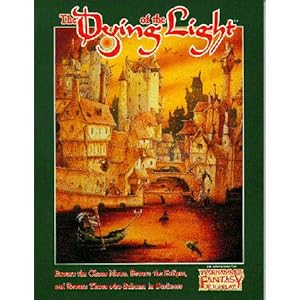
Mine! Mine I say!
I won this module at the Student Nationals in the late 90s when it was held in Glasgow for being the team leader and for us coming 2nd/3rd/4th or something I've long since forgotten. I presume Hogshead provided the prize support. Since no-one else claimed it, it sat on my shelf for years until I started buying the WFRP2E line. It seems to have accumulated significant value on Ebay.

Tangent 1: Not that I plan to part with it - it's mine, MINE, and was probably the only thing I ever got, in lieu of actual gratitude for being DURPS president and organising the society's nationals trip at a time when I had no car, much less a sat-nav and the only driver in the club who'd give me a lift didn't know where Glasgow was. One fellow even wanted an impromptu election at the Nationals to take the post of president off me when it looked like we might actually win, which was gratitude for ya and cemented my "take a hike you ingrates" attitude towards any overtures to get me back on the committee. Anyway, rant over. I didn't feel bad about keeping the module.

This is actually a set of linked adventures by different authors set in Marienburg and the Wasteland, Warhammer's answer to Amsterdam and the Netherlands. It's an interesting scenario as it gives the DM a lot of free-reign in running the scenario. A lot of the text is very conversational, "You might want to do this... if they do this, consider having maguffin behave like X, Y or Z, depending on which you think is more interesting"

It's fairly short (probably it would take 3-4 months of weekly play), but relatively epic in scope. There's some weird goings on in Marienburg, some talk of an eclipse of the sun by the Chaos moon and the city being destroyed. The heroes are drafted in through a rather long prologue that tries to leave the "you meet a man in a bar and he hires you to do the scenario" cliche behind, but instead assumes you've given the PCs a hook to go look up an NPC... who begs them to do the scenario. I'd probably tinker with this - there's some good Marienburg stuff in Warpstone to kick off this campaign with.

There's some crazy stuff in this module. Very little of it is set in the city, it is mainly a wilderness trek with a few rural encounters and sinister apocolyptic tones. One long-banished Warhammer/Heroquest monster makes a welcome entry in a particularly apocolyptic chapter of the scenario that I'm amazed made it past Games Workshop's sanctioning nazis as not only does it feature these creatures but it references Malal, a chaos god that Games Workshop technically do not own copyright on.

Some of Dying of the Light's maguffins are a bit suspect. There's a NPC that certain more psychotic players will want to murder (and only vague suggested consequences for doing so). There's the old magic compass maguffin, basically leading the PCs by the nose. Aside from the fact the writers forgot the PCs might try to triangulate their intended destination it suffers from the old RPG trope of being told "this trail/map/ is the safest route to your destination" and discovering it leads you through a series of suspiciously planned encounters and ambushes. It's pretty easy to fix that plothole in the scenario though.

Another downside is that it is a WFRP1E supplement (although 1E and 2E are pretty easy to convert on the fly. Don't get me started about 3E though!). Perhaps the last disappointment is this is for 2nd career characters. In WFRP you often start with a random and often pretty lame career - such as Rat Catcher or Servant (though WFRP2E wittled this away by making most careers fairly combat-orientated, nobles were no longer fops but deadly fencers, and WFRP3E starting characters are all superpowered gurus). Your 2nd career is typically chosen by you and is a more "adventurer" career. It's also typically when you finally get spells if you are a priest, or decent spells if you are a wizard.

The Thousand Thrones
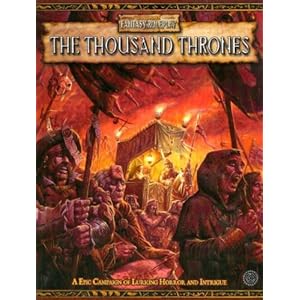
The rather spiffy cover is actually a pretty major spoiler.
The Thousand Thrones is an epic, sprawling beast of a campaign taking PCs from Marienburg into the Empire, and eventually into the distant north. It was designed to use a lot of the WFRP 2nd Edition sourcebooks, such as the Kislev sourcebook. In many ways it is the WFRP 2nd Edition to the Enemy Within - although this is one book with numerous web-enhancements, rather than a series of books.

Set shortly after the Storm of Chaos (a large wargame event that saw Chaos overwhelm the north of the Empire and a possible reincarnation of the Emperor-God Sigmar managed to defeat its leader at the cost of his own life) this is one of the few Warhammer 2nd Edition scenarios that actively builds upon the events of that campaign rather than generically paying lip-service as part of Games Workshop's edicts at the time.

Tangent: It's worth noting the designers of WFRP suggested they make the rulebook setting neutral (i.e. pre-Storm of Chaos) and release books and adventures to handle the Storm of Chaos. Lead designer Chris Pramas suggested options for letting you play before the Storm, one during and one in the Age of the Three Emperors, but no, Games Workshop knows best. Incidentally the new WFRP is set before the Storm of Chaos.

A possible new incarnation of Sigmar has come to prominence, and has been blessed by the exiled Grand Theogonist Esmer. The PCs must chase after this charismatic avatar, leading to all sorts of interesting scenarios. It's a complete 256-page campaign crammed with information (the font size is criminally small) that could easily take a year or so to play through (though the campaign could end earlier depending on player decisions). I mananged to get it for about £15 on Ebay so I'm giggling.

In many ways it calls back to Dying of the Light. It is written by several authors and each chapter is a mini-scenario in itself. It begins in Marienburg but sends the PCs away chasing a maguffin fairly early on. It is probably best not played by ultra-lawful characters (no zealots, witch hunters and fire-brand wielding priests of Sigmar) as some of the maguffins involve working with Chaos infected characters.

There is a good mix of investigation and combat, though I'm only really familiar with the first half of the campaign. The ending of the campaign is notoriously rotten, resembling a player-killer dungeon crawl. Also like Dying of the Light the beginning scenario assumes the PCs are somehow already involved in events and does not provide more than basic hooks to get the PCs involved in the scenario - it is largely left up to the Dungeon Master and the player to play ball.

I listened to this being played on the RPGMP3 website. This is run by an exasparated Brit expatriate and played by a group dominated by Texans who sound like Yosemite Sam and really, really struggle with the more intellectual and investigative aspects of the scenario. Worryingly they remind me of when I was 17 and 'trying' to play Call of Cthulhu. It also highlights to me why the DM must have razor sharp adamantium hooks to ensure the PCs remain motivated to investigate the maguffin of the scenario.

This is not a ready to run campaign on its own, unlike earlier WFRP 2nd Edition scenarios. The Thousand Thrones as provided is a reasonably interesting campaign but significant tinkering is required to keep it on track, particularly if the characters go off track.

There is substantial online support and advice on tinkering. One of the authors, Jude Hornburg, has released several online supplements for it and it's nice to see as some WFRP 2nd Edition felt a bit 'churned out' by freelancers (like the ubiquitous Robert J. Schwalb, who wrote many of the more so-so supplements as well as the much criticised end to this scenario. Though to be fair he is credited with also coming up with the interesting central concept). Jude's latest effort will include an introductory scenario that actually gives the PCs hooks to follow the rest of the campaign.

Own Stuff

For a while I've been tossing around a WFRP2E campaign idea I came up with called "The Ruinous Powers That Be" when overdosing on George RR Martin stuff. I've actually written most of the first scenario up as a full PDF, with the second scenario being . At once point I considered making the 2nd scenario my Nationals scenario, but as the category I'm running in is "Action" chasing drug-dealers and phantoms around the hills didn't really seem classically action enough.

The other campaign idea I've been tossing around is a Bretonnian campaign where the PCs all play downtrodden peasants, based on Graeme MacNeill's story, Freedom’s Home or Glory’s Grave with a smattering of Robin of Sherwood, Edgar Allen Poe and the French revolution thrown in.

Saturday, March 10, 2012

Knights of Bretonnia: A Review


Bretonnia is a controversial Warhammer Fantasy Roleplay topic. Originally setup as a thinly veiled plagiarism of Dumas's France with decadent nobility, downtrodden/starving peasants and gun-totting musketeers the entire nation was wholly retconned in the wargames to an Arthurian setting, with chivalry, castles, knights and even a grail-totting Lady of the Lake.

Personally I don't mind the resultant change (I do like my knights as you can tell from some of my old RPG work), though I do hate such a clumsy large-scale retconning in an established world (a reason I do not read superhero comics, particularly DC and Marvel). There are even printed stories set in the old Bretonnia that are now no longer part of the established continuity, and a lot of the older Warhammer Fantasy Roleplay sourcebooks make mention of decadent Bretonnia and its uncaring king Charles de la TĂȘte d'Or. The new king is Louen Leoncour, a valiant warrior (probably more conveniently marketable in a wargame than a man with a wig telling people to eat cake).

The last Warhammer supplement I bought before my long RPG vacation was Knights of the Grail. I was pretty psyched when I bought it. I liked the dark Warhammer feel, and I also loved Arthurian games like Pendragon so this was a must-buy. What it turned out to be was a strange book, lacking any detail or direction (a problem with a lot of WFRP2e supplements, doubtless to avoid conflict with the wargame campaigns), seemingly portraying the knights as noble and valiant but also showing the peasants rising up against the nobility. There was also an annoyingly apologistic sexist attitude in the book, with women being 2nd class citizens and effectively barred from entry to most careers (like say knight) but every 2nd ed Bretonnian adventure featuring a pre-generated female character disguising herself as a man. It just bored me as a plothook and made me think of the stoning scene in Life of Brian. There was no real cohesion or indication as to what threats Bretonnia faced, other than internal bickering between peasants, nobility and women with fake beards.


So this was my motivation for reading Knights of Bretonnia and from that point of view I was not disappointed. The book is actually an omnibus of 2 novels, 1 short story and 2 novellas written to close out the sequence.

Knight Errant is the first title in the series. A knight errant is basically a young nobleman riding around Bretonnia looking for trouble. Basically imagine a young David Cameron on a horse 'righting wrongs' for the residents of Chipping Norton. Young Calard and his younger half-brother Bertelis, both sons of the ailing Castellan of Castle Garamont, end up riding with a force of knights to hunt down some orcs, expecting more wine and women than battle.

This is not the most cerebral of reads - it is unashamedly a hackfest of a Warhammer novel with the knights beating up some orcs, and only then realising the orcs were running away from a far superior force of beastmen. Along the way they face intrigue from their own rivals within the Bretonnian forces, as well as a small faction who want Calard dead so that Bertelis can inherit the castle. Which might include Bertelis's mother.

The other character we follow is Chlod, a wretched peasant outlaw who spends much of the book scheming against Calard and generally trying to stay alive. Something not very easy to do when you are a masterless peasant. The life of a peasant is horrible in Bretonnia, with practically anything other than digging your ditch and charging the enemy with a rusty spoon when your liege asks resulting in a sentence of death.

It's worth noting Chlod almost gets a free pass on this kind of behaviour. The nobles, including our heroes, clearly care little for the peasants in their charge - the knights have their men-at-arms toss the peasants off the battlements when they've died in battle, when they see a village that has been raided by beastmen they toss all the peasants in a mass grave and leave the survivors to cope on their own. The knights canter around on fine horses and expect their men-at-arms to keep pace, often not allowing them time to rest. Worshipping the state goddess the Lady of the Lake (Bretonnia's answer to Sigmar) is punishable by the death if you are a peasant. Peasant men-at-arms keep roughly 5% of their pay. And so on.

Sometimes it beggars my belief how rotten the noble characters are to peasants (especially Bertelis) and why the peasants do not rise up (though I believe there is some mention of peasant rebellions and how they typically fail, and one short story, Glory's Grave or Freedom's Hope does tell the tale of a settlement mentioned in Knights of the Grail that has declared itself a republic). Given the lack of gunpowder in Bretonnia all the peasants would need to do is somehow steal some guns from the Empire or Marienburg and they would have a sizable tactical advantage if they dug in against the nobility in some foresty or hilly terrain. Of course that relies on them getting enough cash to obtain such items...

Sadly some of the above violates the "show, do not tell" rule. The most prominent example in Knight Errant of this is that we are briefly given the backstory of a man-at-arms in the final parts of the novel - about how he was groomed by his peasant father to be a man-at-arms, how he passed the stringent physical checks (unlike the other deformed peasants), how he had to pay for his equipment and expenses and was left with a pittance, and how hard is life was. It felt a bit preachy, that perhaps such a character should have been introduced more subtly if he had appeared earlier in the narrative. He is also killed off a mere heartbeat later, reminding me of a similar character in the last episode of Stephen Moffat's Jekyll.

Errant does however portray Calard as just one lance in a sea of similar Knight Errants (albeit one from whom the plot is more personal). He is often shadowing higher-ranking superiors, such as his trainer Gunther, his commander Baron Montcadas, the Imperial ambassador Dieter Weschler (a character I felt the novels probably could do without), the Grail Knight Reolus and his own sister who at childhood was taken away by the Fay to be a Grail Damsel, a sorceress. I often call this 'Harry Potter syndrome' where the lead character is subservient to, and often bailed out by, more powerful characters and rarely gets a chance to prove himself. It ends with some all-too predictable revelations that you could guess from the prelude about Calard's bloodline, as well as the promise that his life (and avoiding assassination by his own kin) is not going to get any easier.

Knight of the Realm is a more solid affair with witchery, devilry, demon-impregnation and Norse raiders being the threats in the second book. Calard is now a drunkard, plagued by visions. Former drunkard Bertelis is now obsessively trying to master the sword. The novel deals with their various plights and gives them a reasonable amount of development, along with a large protracted siege of a city. The Norse want the knights to surrender a demon-child they impregnated Elisabet, one of the characters from the first book with. The resolution for this is particularly mind-boggling. The Norse propose a one-on-one match between their Jarl and Grail Knight Reolus. Grail Knight Reolus loses and Calard gives the Norse their demon-kid, vowing vengeance as he does so (and not losing his head in the process of posturing). The Norse all naff off in their longships, vowing to come back when the child comes of age and kill everyone. I personally didn't buy that. The Jarl seemed like an honourable-evil chappie, but the rest of the force were bloodthirsty beserkers. The Bretonnians were helpless!

The novel continued to derail at the end with the 'murderous family' plotline petering out. Calard and Bertelis have a major falling out over a maiden Bertelis accidentally killed (fair enough). Calard then catches and deals with the man who has been sending assassins after him, and turning his own kin against him... between the last chapter and the epilogue. This beggared belief for me, as this was one of the more interesting plots of the novels and could have been held in reserve for a later story.

The novels end here and we are left with short tales of Calard as he renounces his title and seeks to become a grail knight to replace his fallen mentor Reolus. He also takes with him Chlod, who has been bumbling around in and out of trouble for most of the two novels. The first short story, Eternal Rest, is a reasonably interesting and solid affair involving the pair of them encountering a wyvern and the knight who seeks to kill it.

The first novella, Questing Knight, sees Calard return home after 5 years to find his home in ruins, and all within dead. His old rival Maloric is now married to his sweetheart. At first he accueses Malorc but it turns out the trail leads to the cursed Duchy of Mousillon. Overall things are fine again until the climax. It's clear Reynolds probably needed a largish novel to wrap things up to my satisfaction. The start of this novella sees a lot of the established cast killed off in a relatively meaningless way, stripping away a lot of interesting potential for Calard's development.

It does resolve Bertelis's fate. Bertelis had taken up with a knight he had met in a tourney at the beginning of Knight of the Realm. This knight turned out to be the reincarnated vampire duke of Mousillon, who was five years ago visiting random tourneys and is only now raising an army of undead (all for these actions and the generous timescale are never explained). This means the shock reveal is that Bertelis was behind the razing of Garamont. Sadly he is reduced from a complex character, torn between conflicting family loyalties, to a chuckle-head vampire minion who Calard dispatches with help from a rogue knight in the climax of the novella. Chlod is given a little bit of development as well, as we learned earlier in the sequence he was from Mousillon. However Calard just ups and leaves Mousillon, the evil duke and its army at the end of the novella, having a vision from the author sorry... the lady of the lake.

To say that Questing Knight felt rushed is an understatement. I would like to have seen this developed into a novel with Castle Garamont still standing (at least for a while) and more intrigue. This is the last we ever see of Malorc, Calard's old rival, who was an interesting foil for Calard, being a knight of equal standing and despite his prejudices and hatred willing to fight alongside Calard.

Grail Knight sees Calard having ditched Chlod and gone solo, leaving them to go warn Bretonnia there is an undead army coming over the hill while he deals with this story's maguffin. This involves him tooling around wood elf country and eventually helping them. There's enough tedious misunderstandings between the elves and the human which make the elves look like douches (yes, the knight swam into a river, bound your wounds and took you to a cave - obviously your elven superiority says you should steal his sword and try to kill him). Eventually it is revealed that he is being guided by his sister to find and participate in some sort of elven-forest-god rebirth ceremony (I must admit a lot of the high-level wood elf pantheon stuff that goes on in this story went over my head). They are so happy with that they can ride out and help the Bretonnian's fight the Duke of Mousillon. Oh, and Calard finds and drinks from the Grail, making him a Grail Knight. Sadly this dorsn't feel particularly integral to the story.

There is a suitably epic ending to the fight in which Calard, now infused with powers from drinking the grail, kills the vampire Duke, saves the king and the day. There is even an additional epilogue where many years in the future he prepares to face off against the returning Nords and their demon child. This gives us a brief mention of the fates of our supporting characters, but it is very brief. For example we do not really find out what happened to Chlod other than he "did better than anyone expected". We find more concrete information about Dieter the Imperial Ambassador's fate and he hasn't appeared for 3 stories!

Again I feel these two novellas could have made a more interesting conclusion if they had been a longer novel, particularly if the second novella did not feel so divorced from the previous one at times. By the end of the book I did care about Calard, Bertelis, Elisabet, Chlod, Montcadas and even Malorc. I did not really care about xenophobic wood elves introduced at the 11th hour.

In terms of learning more about Bretonnia this story fills in a lot of gaps missing from the sourcebook. We learn how downtrodden the peasantry are (and some reasons why they don't or can't rebel), we learn the Norse are the primary Chaos threat to the nation and we also learn the nobility themselves have their fair share of corrupted bloodlines and interesting interpretations of what chivalry and honour are.

There's little discussion as to the nature of the Grail in either these novels or the Bretonnia sourcebooks. The sourcebook outright states the Fay and the Lady of the Lake are elves. This perhaps means the Grail itself is an elvish artifact, or at least an artifact they have appropriated. The society of Bretonnia is kept deliberately stagnant (resembling feudal England and France while other societies have a renaissance feel to them). There is clearly something pretty interesting going on in this area - the grail has an uncomfortably cultish and brainwashing effect on those who come in contact with it. For example I was chilled by one of Calard's first remarks about how on drinking from the grail his life, like his sister's is "no longer his own". I was also intrigued by Grail Damsels, though I would rather take a more down-to-earth approach to them in the setting as they are meant to be quite common in the cities of Bretonnia. I would imagine a rather bitchy coven of these powerful women would make an interesting tale!

Overall, a good relaxing read, but sadly some story-threads are just dropped in the cycle. I suspect this might appeal more to a younger readership who prefer sieges, elves and pixies over solid intrigue, treachery and character development. There is quite a lot of interesting stuff to be done with Bretonnia though.

Friday, March 02, 2012

Matthias Thulmann: Witch Hunter Review


Fresh after finishing Marks of Chaos, as part of my inevitable putting off of reading a Feast for Crows I read the Warhammer: Matthias Thumlann, Witch Hunter trilogy...

Way back in the dawn of time when I bought my Warhammer Fantasy Roleplay 2nd Edition book I was offered the first part for free. As it was the most WFRP-like novel on offer as part of this deal I accepted.

Matthias Thulmann could be taken out of the Witch Finder General movie with Vincent Price. His description certainly matches that of Price's Matthew Hopkins, and his often cruel mercenary sidekick Streng is a Warhammer version of Hopkin's sidekick Stearne. Werner, the author, is a big Robert E. Howard fan and in many ways he is also emulating Solomon Kane, a zealous Christian puritan swordsman hero, with his Thulmann stories. He has another character, Brunner, who sounds an awful lot like Robert E. Howard's Conan during his mercenary era.

The omnibus book has three short stories. The first of these is a run in with Chaos cultists that sets the scene nicely, the second is a medieval zombie survival horror story and the third is a witch hunt that links to the start of the first book. It seems a bit cheeky to make the last story interconnect with the first book - I read the book first and was confused by references to a seemingly non-existant set of adventures. This is how the character was first introduced and a continuity-freak like myself should not really complain.

The main story in the three volumes concerns Thulmann's search for an evil scientist (though the trail only picks up in Book 2) and various shennanigans pertaining to a sorcerer's spellbook. The book was stolen from a vampire and used by witch hunters for their own interesting purposes, but now a whole host of characters want the book back. One character, a villianous necromancer, is always in the background throughout the trilogy, but is never seen by the heroes.

Books 2 and 3 concern the book falling into the hands of the scientist and his skaven buddies. The skaven are written fairly menacingly, though I often feel they are overused in Warhammer. (Mind you this probably stems from when I started roleplaying with Advanced Heroquest. Skaven were the only monster you got in the box). I'd love to see a story or even a Warhammer adventure with fimir behind the nefarious goings on.

My problem with the continuance of the "get the book" arc throughout the novels is it starts to feel a bit old. Enemies are seemingly killed and come back with worrying regularity. At times it feels like watching a season of "Whacky Races" or "Stop the Pigeon". With Carrandini the Necromancer in the role of Dick Dastardly, usually ending the episode driving off a cliff and his car exploding yet emerging next week unscathed. Book 2 in particular does not stand on its own as a read - the ending is abrupt and a sizable amount of the third book is spent rounding off the second book and getting our heroes out of Wurtbad.

I would like to have seen Thulmann investigate a few new cases, perhaps some Chaos cultists in Altdorf or Marienburg. There is actually quite a lot of backstory of old cases hinted at in the story for Thulmann that I think would make for an interesting collection of short stories - and certainly more interesting than some parts of Book 2, which really dragged in places and yet also felt too short.

My favourite book is definitely the first one, though the third one picks up once our heroes leave Wurtbad, the setting of the 2nd novel. In Book 1 and the short stories our main characters are quite dark anti-heroes - Streng is an expert in torture and seems to enjoy his trade, Thulmann is happy to threaten his innkeeper to ensure he gets the best room in the tavern and the best food. He gets little help from the local lord, an ex-witch hunter, and there are conspiracies with conspiracies, including a nice little twist I didn't see coming.

In the second and third books the two main characters become more 'good'. Thulmann's high-handed and haughty manner to peasantry is explained (or dare I say retconned) as being an act - a necessary evil, as a witch hunter must be feared by the populace in order for him to function properly. Even Streng has some redeeming moments as he shows he might actually care about his employer and goes beyond what I would consider reasonable for a hired thug. Personally I was happy for the characters to stay very grey. They still do questionable acts, but compared to their peers it is pretty clear they are saints who go by the book.

This comes across a bit odd in the third book when they are teamed up with more zealous and self-interested members of the Church of Sigmar. There is the inevitable clash between the zealots and a group of peasants hiding a mutant child. Thulmann intercedes on the mutant's behalf, trying to stop the zealots from having a good old burning (almost a 180 from how I felt the character was initially portrayed) by saying they have more important things to do. Then later on in the book the villagers are revealed to be in league with the bad guys... making the zealots right in hindsight to want to burn the mutant. I personally thought that was a bit odd - but that's life I suppose. If they zealots have already gone to the bother of arranging a lynching why not just go through with it? (Mutants in Warhammer are a brilliant storytelling mechanism as ultimately there is something sympathetic about someone shunned in society through no real fault of their own).

As to the church there is some interesting politicking in the Church of Sigmar. Events from Marks of Chaos get a mention, as Gamow, the Lord Protector of the Templars of Sigmar (i.e. the head witch hunter) died in suspicious circumstances during the events of that novel. In this trilogy we learn that the Grand Theogonist Volkmar has decided to replace him with three new Witch Finder Generals, rather than give one man all the power. However the third book has Volkmar replaced as Grand Theogonist by Johann Esmer and Lord Bede about to be is installed as his Lord Protector. Apparently in the Warhammer Fantasy Roleplay books when Volkmar returns from the Storm of Chaos he brings back the three Witch Finder generals! Confusing!

The Grand Theogonist thread is part of the Storm of Chaos metaplot, and a bit jarring in this book as it doesn't really lead anywhere. This is probably the downside of a shared universe where the Storm of Chaos was intended to be a massive crossover event that affected even the novels. The new Lord Protector is to make the stories consistent with Marks of Chaos. The author goes to some pains - even Sister Karin from Marks of Chaos gets a brief mention in the third book, so extra marks for that.

Silja Markoff, a character introduced in the second book, is not a character I am keen on as she becomes the mascot for the "softening" our protagonists in the later books. She seems to be the quintessential 'generic adventurer' who is employed as an agent for her father, the Lord Justice of Wurtbad. This is a job that seems to leave her completely free of responsibilities (especially given what happens to Wurtbad in Books 2 & 3) and able to up sticks and follow our hero. She serves as the romantic interest, something that I find somewhat jarring when our main character should be a cold religious zealot. However if Werner kills her off in later books I'll give him a free pass on this - that would be an interesting twist and could send the character to a really dark place.

It's also worth noting the story ends on a cliffhanger after 3 books. The last book was published in 2007 and the author does plan to return to the series but says that we should not expect anything new for Thulmann imminently.

Overall it might seem I'm being critical of these books but they are a decent read. I hope to see more Thulmann.

Friday, February 10, 2012

Marks of Chaos Review


Marks of Chaos is a print-on-demand book available from the Black Library. It's also the first Warhammer novel I bought online. It comprises of two novels, Mark of Heresy and Mark of Damnation, as well as two short stories, No Rest for the Wicked and A Night Too Long.

The sole reason for me buying this is because I have long admired the author, James Wallis, for his work in the games industry. I was a big fan of his old company's (Hogshead Publishing) output for Warhammer Fantasy Roleplay as well as some of the other games he put out.

The man can write innovative games, such as The Extraordinary Adventures of Baron Munchausen - a game I can boast I have the Gentleman's Version (not the commoner's Wives and Servant's Edition). Sadly not all of his projects panned out - in the twilight times of Hogshead he was going to rewrite the original ending to the award winning Enemy Within campaign until a hard disc crash destroyed his draft and probably his will to start all over again (if only Dropbox was invented 15 years ago).

I have the original ending of Enemy Within - Empire in Flames and on paper it is a relatively good scenario. It's even got a fantastic mcguffin that I think players will enjoy, a fairly epic climax and epilogue that would satisfy any player characters that has slogged through the entire Enemy Within Campaign (and trust I only got as far as finishing running Shadows over Bogenhafen with some players who all-but-mutinied against the dark, dark plot.

Wallis stated his Empire in Chaos would be even better, and given Marks of Chaos I am willing to bet it would have been a really memorable climax. I'd also be glad I was the one sat behind the screen rather than playing as his novel puts the protagonist through the ringer and then some.

The story concerns Karl Hoche, a loyal lieutenant in the Imperial Army. Now at the start this sounds like bog-standard Warhammer but Karl very quickly finds some things are amiss in his unit and is unceremoniously parcelled off to Altdorf to report his findings to the regiment heads. It all goes south and Hoche ends up joining a secret branch of the Reiksguard called the Untersuchung (German for Analyse), a spy organisation that hunts Chaos within the Empire. It is the only way to stay safe from the regiment that want him dead to preserve their honour.

From this point on the novel shifts from the archetypical Warhammer fighty-fighty teen prose to a fairly tense spy-novel full of intrigue and nastiness. Hoche gets trained up in espionage and infiltration but realises pretty quickly that various factions within the Imperial forces are engaged in petty politicking against one another. For example the Witch Hunters view the Untersuchung as heretics. The Untersuchung view the Witch Hunters as unsubtle plods who would rather burn old ladies than do the legwork. Then there's the fact the Untersuchung is only part of the Imperial guard as a technicality, and that both they and the Witch Hunters have also been infiltrated by a group known as the Cloaked Brothers. This is a shadowy faction of ex-witch hunters content to observe Chaos and eventually defeat it by using that knowledge. So content they do not try to stop their plans.

This is also the same Warhammer as the Enemy Within campaign, so that means the upper echelons of Imperial society is compromised by Chaos cultists. The Powers that Be are just more likely to hinder or even actively kill our hero than help - either because they are cultists or because they are duped by their superiors who are cultists.

Plenty of cults abound in the book. The Purple Hand, a deep-cover cult and one of the main villains of the Enemy Within, make an appearance. So does the Ancient Order of Illuminated Readers in Marienburg, explaining what happened to them after James Wallis's (and plenty of other authors) own Marienburg-based Dying of the Light scenario. This was an order of readers who literally pulled their own tongues out to prove they would reveal the cult's secret lore, and since the Dying of the Light they have gone even further downhill into wickedness. There is also a new Khorne cult - the unsubtle Blood Chaos God - who Wallis nicely weaves into the narrative.

As I said this feels more like a spy novel than a wargame novel (not say there isn't a few scraps along the way). The closest I can think of his that Hoche is akin to 24's Jack Bauer, at least in the first season when Baeur was a human being and not an invincible action movie character. He's permanently relying on his wits first and is being hounded by both the supposed-good guys and the bad guys.

About 1/3 of the way through the book the plot kicks in. The Untersuchung is disbanded for heresy (a point some readers regret, although Hoche's mentor is never explicitly seen dead). Due to a botched mission and torture by a highly placed Chaos cultist he is left with a mutation and delivered to the Witch Hunters to be tortured. It is never quite clear how he gets the mutation, it seems to be a combination of tainted meat and a cultist's knife.

This is a point where the book really excels. In other Warhammer novels mutation is used as a McGuffin to give the hero superpowers like some sort of X-Man. Here it is shown in all its horrors - the gradual loss of humanity, the disfiguring of both the soul and the body. Hoche's mutation is rarely a blessing, but often a curse. Over the course of the novels Hoche's physical corruption manifests in more and more overt ways while he tries to stay mentally pure and set himself the task of destroying as much Chaos as he can before he inevitably succumbs to its lure. There is no possibility of redemption, no reprieve and no magic McGuffin that will save him. Only damnation waits, and living each day to fight Chaos is a victory in itself.

The conclusion of the book sees Hoche eventually track down the true followers of Chaos and thwarts their plans, leaving himself branded a mutant and a traitor (which in the roleplaying game is usually a sign you did the scenario successfully). There are sufficient followers of Chaos in the Imperial faction to ensure he is blamed for their botched plan and he leaves alone to hunt down Chaos wherever he finds it.

The second book revolves around the Storm of Chaos event, a big metaplot for the Warhammer tabletop wargame. Sigmar is reborn as a man and the forces of good must find him before the Chaos cults do. These good guys have formed a holy crusade, led by a Sigmarite priest called Luthor Huss, and have been denounced by their church's authorities as heretics. Hoche falls in with the renegades as they search for Sigmar, all the while being unable to show his true nature to anyone. He ends up as a leader of the Crusade and is instrumental as a background player in location the reincarnated god and getting him past the Chaos cultists who have insinuated themselves in the Imperial court to the Emperor.

After an amusing and bloody scene with an enemy Imperial steam tank Hoche is left alone by Huss and Valten, the reincarnated Sigmar, on the gates of the Imperial Palace. He has walked into the stronghold of his enemies and must face the Witch Hunters the Chaos cultists have sent after him.

The book ends with Hoche triumphant however. He thwarts their efforts to kill him again, even proving to some of the good guys that he is truly a good man still in a strange world where the leaders of Order are actually the servants of Chaos, and a mutant is the hero.

It's a relatively deep and horrifying pair of books, following Hoche's descent and struggle for humanity. Other characters join him but ultimately Hoche is alone. This does lead to some excellent set-pieces, whether its interrogating a witch hunter on the privy at crossbow point or commandeering a steam tank to get Sigmar Incarnate through the compromised Imperial forces.

Sadly the "Wallis Unfinished Series Curse" hit again as it did Empire in Chaos. It’s a testament that the books are called "The Chaos Hunter" series but it is only mid-way through the second book Hoche earns that epithet. The author was unable to commit to writing more books in the series, originally planning 4 books but life forced him to leave it at two. The third and fourth books would have seen Hoche sacrifice his life nobly to remove the cancerous cultists at the heart of the Empire in the town of Middenheim, only to be succeeded by one of his followers as the Chaos Hunter. (Snark: Which is better than him sticking around for 12+ novels with a death wish and becoming superhuman, unlike some other Warhammer books).

Given the retconning of the Storm of Chaos (current Warhammer Fantasy Battle presents it as only one possible future for the Warhammer world) I am uncertain as to whether Hoche's tale will ever continue in any form, though without Wallis perhaps that is just and fair. A different author might lose the feel of the novels.

Overall this is an excellent buy. The two short stories are more of a buddy-cop show involving two Palisade members (seemingly Secret Service operatives) investigating shenanigans in Altdorf. Fun stuff, but the novels are the real highlight of this omnibus and can be gotten in 2nd hand bins still.

The only criticisms I have is that sometimes the plot is a bit too smart, sometimes characters (including the hero) can be a bit stupid or razor sharp - but this reflects how I find myself sometimes. There is a little cliché, such as the rabidly fanatical witch hunters who are either corrupt or cannot find corruption when it stares them in the face but are willing to hound the innocent. Thankfully there is a counter-example to this in the second book, but here the witch hunters don't come off well.

C.L. Werner, whose excellent Warhammer Witch Hunter books I will discuss another day once argued the Cloaked Brothers in particular seem unnecessary and somewhat tacked-on. It's worth noting that Wallis admits he was building up to doing something conclusive with them that would have been seen in books 3 and 4. I would argue they drive the entire plot in the first book and are a mirror to Hoche in some ways - people who see Chaos everywhere in its wickedness yet coldly do nothing, while Hoche becomes a folk hero for attacking Chaos wherever he finds it without thought for self-preservation. Which is because the man has nothing to lose in dying.

Sunday, February 05, 2012

Hammers of Ulric: Why It Sucks!

This book was dreadful. Simply dreadful.

Which is a shame as one of my favourite areas in Warhammer is the City of the White Wolf, the closest thing to Minas Tirith in the Empire. It was originally the focus of a Warhammer supplement by veteran designer Carl Sargent as well as the setting of an excellent adventure, Power Behind the Throne - the last canon entry in the Enemy Within campaign. Much like Marienburg a lot of the city's stories should write themselves.

Enter the authors, Dan Abnett, his wife and James Wallis, author of the excellent Marks of Chaos series and the reason that I read this 'book'. One of my friends exclaimed surprise that I hated it as she is a fan of Dan Abnett's 2000 AD material.

I got this book in an anthology of "Dan Abnett Warhammer Fantasy Novels". Abnett is one of the more prolific Warhammer 40,000 book authors - which I assume his 2000 AD experience translates better into. I was however a bit put out - these novels are all co-written with author people who do not appear on the cover. Seems a bit shocking to me.

The book consists of short-stories that were originally in Games Workshop's fiction magazine. Later on the stories are shoe-horned into an overall arc-story that is supposed to tie all the threads together.

The first story relates to the titular Knights of the White Wolves. In the foreward they are described by Abnett as "proto-space marines" and it really shows in their lack of personalities. I could just as easily describe the cast of a cliched war movie or Charlie Sheen's Hot Shots - there's the gambler, the Porthos-like drunk, the fresh-faced new recruit, the veteran traumatised by a failed mission and can't kill anymore but like Miguel Ferrier in Hot Shots will be cheerfully slaughtering enemies by the end of the first story thanks to the new recruit, the commander on his first mission.

I can summarise the plot of the first story - the knights lost their last sortie against some beastmen. Their colours were taken and their leader was slain. Now they ride off and kill the beastmen with only a few minor casualties - one of whom had it coming anyroads. End of story. No real twists. The descriptive prose doesn't hang particularly well in my opinion but it is a very short story.

The highlight of this novel is the second and fifth stories by James Wallis. They involve a priest of Morr who investigates crimes and prefers to use his brain and underworld connections rather than his muscle. These sections are well-worth reading and really are the saving grace of the novels. There are some twists, I didn't see them coming - you might though, but the overall descriptive prose drips with atmosphere.

Needless to say when the death priest character is later parcelled off to Abnett's main narrative he is borrowing knives from the Wolves and charging a horde of cultists.

The third story involves a kid who is naturally invisible, and a thief he befriends. All is sweetness and light as the thief gets the kid to steal for him and pay his qutoa to the Underkings (thieves' guild). Eventually they do a job to rob a cult that nearly get them both killed, with the kid sacrificing himself to let the thief get away to safety, as he was the kid's only real friend. Awww.

This doesn't seem very Warhammery to me and it is not explained why the kid goes unseen by most people. I would assume it is a mutation of some sort but the story doesn't bother to explain this. Sadly that's not the only thing relating to this kid that is not explained...

Story Four sees the Knights of the White Wolf dealing with the evacuation of a manor and some ghosts. Some of the dead knights are replaced with new knights, but for the most part they're all interchangable. This story also introduces my least favourite character in the story, Lenya the milk maid, who becomes a love interest for one of the new knights.

Story Six, curiously starting hours before the end of story four, is the story of the milk maid. Having arrived in Middenheim she starts looking for her long-lost brother. Pretty much the entire cast of the novel, the Knights of the Wolf, the death priest and even the thief from story 3 all bend over backwards to help her, despite the fact she acts like a bitch to the knights, and the thief has no real motivation for trying to help her.

As she drags various characters through Middenheim I spent the story going, "The brother will turn out to have been the invisible kid."

Guess what the twist was? Lucky she met the one guy in the massive city who knew him. This also make little sense - Lenya knows her brother has this 'gift', that people don't notice him and really it should make looking for a man no-one can remember a futile effort.

Story Seven is I suspect the beginning of the chapters written to make this into a novel. The knights of yawn go and fight an undead beastie that has half-inched every organisation in Middenheim's sacred items. The story ends with the beastie being knocked flying by a warhammer and flying off, vowing vengeance...

which it gets in Story 9, getting a new body.

A but let's not forget Story 8! The milkmaid sends her knight-lover and his buddy to rough up and capture the thief who saw her brother die. That's it really. It ends with him being understandibly pissed off with them.

Story 10 is the exciting conclusion. Well the conclusion.

The undead liche from Story 7, with his cult (from story 3) have cursed the city. Plague runs rife, a war with Bretonnia looms and people are going mad and murdering each other. The knights of the wolf investigate - getting the entire cast together. The thief even returns to help, despite again having no motivation to do so, leading the knights and death priest to where the kid died - the Cult's Headquarters. They fight through traps and encounter the cult, described as "hundreds of worshippers down there, robed, kneeling, wailing out a turgid prayer".

They also have a dragon tucked away there. Yes really!

So what do our heroes, a mere 15 or so knights and a death priest do? Sneak? Come up with a plan? Nope - they charge. And win with only minor (i.e. unnamed characters only die) casualties. The Grim and Perilous world of Warhammer eh! Everyone faces off with the liche, who can even explain all the unresolved plot-threads in the novel and even tries to tie together all the earlier magazine stories.

Meanwhile milk-maid and an injured knight decide the others are in danger so they ride across the city, pausing only at the Sacred Flame of Ulric (the central holy site mentioned exactly once in the book, back in story 1) to set his warhammer on fire. They then ride across town, finding the cult HQ (which remember the thief had to lead them to), getting through all the traps just in time to stand up to the liche. Milk-maid Mary Sue takes the flaming warhammer off her knight-escort and kills it with a well-aimed throw. Incidentally how goes is a two-handed warhammer as a thrown weapon? In this book it seems to act like a boomerang.

Not to be outdone in illogic and cliche, thief-boy inexplicably gains the kid from story 3's invisibility power and uses it to find the weakspot in the dragon, killing it and earning his spurs as a knight. The story ends with a Twilight-situation between the urban-milkmaid and her two paramours - the thief she had roughed up and the knight she's treated like crap all the way through the later parts of the novel.

Overall this novel is cliched, boring and heavily reliant on ridiculous combat situations where our heroes always seem to emerge unscathed. Logic is left out in the cold, while deus-ex-machina is the order of the day.

Thursday, January 19, 2012

Fiction Snob

My attitude towards fiction based on games and TV shows is to generally avoid unless it is really, really compelling stuff. A certain someone describes me as being a bit snobby towards these books.

It's for that reason I've never read a Star Trek novel (except for the first Shatneverse novel, and that was originally as a comic). I view reading a book as a commitment and since most TV/game spinoff fiction is dismissed almost instantly as non-canon (you'll never see an episode of Battlestar Galactica that references the novels or comics) and is a cheap disposable way of ringing money out of a fans of a franchise with prose that might as well be written by monkeys intent on churning out 5 cents a word.

It started when I was beginning to play Dungeons and Dragons. I found Dragonlance in our school library and rapidly developed a love for Krynn. After reading the six prequel books, the six books on how the main characters met, the main trilogy, the secondary trilogy and the trilogy of short stories, as well as numerous other spin-offs I rapidly felt I was reading the same book over and over. I finally stopped Dragons of Summer Flame, which was arguably an unnecessary novel.

I've rapidly found - for instance reading an HP Lovecraft or Robert E Howard tale is far more satisfying than reading Kevin J Anderson's Star Wars/Dune/X-Files churned out crud. So you probably won't catch me reading Halo novels, or Dragon Age: Story of Minor Character Bob on my kindle.

There have been exceptions to this - I've read the Star Wars Zahn Trilogy (good, but didn't really feel like Star Wars and the author tended to give all the characters identical tics - count how many characters exclaim 'Point' in those books). Another was the Babylon 5 novel To Dream in the City of Sorrows (I like the character of Sinclair and wanted to know what happened to him, and JMS, the B5 head-honcho states in the foreword this book is completely canon/accurate).

Since getting an e-reader though I've become more willing to experiment with my reading - to the point where I've read some uncharacteristically unusual stuff. Some reviews of this will be forthcoming shortly.

Sunday, November 06, 2011

Stuff I've Been Reading: George R.R. Martin's Tales of Dunk and Egg

A whileback when HBO's Game of Thrones was on TV I whizzed through the novel like the devil was on my tail. When the time came to get into Book 2 I started reading and while I have to admit I enjoyed it I did stall round about the one-third mark and started reading (of all things) Ravenloft fiction instead.

What brought me back to Martin's epics (I'm now just finished A Storm of Swords:Steel and Snow) was when I sat down to read his three short stories, The Tales of Dunk and Egg. These are 3 novellas that feature in different fantasy anthologies George R.R. Martin has written. They are all set in Westeros and set 100 years or so before Game of Thrones. As novellas they weight in at around the 100-200 page mark, which is as punchy as Martin gets, suffering from as he describes it "diarrheoa of the wordprocessor".

As a prequel they've often been described as analagous to the Hobbit, but really they are three episodic tales featuring Ser Duncan the Tall, a hedge-knight (wandering knight in the ronin tradition) and his unique squire, Egg. Typically Martin has indicated there will be several more stories, as many as nine to twelve, covering much of the life stories of the two protagonists. There are only three written, with a fourth on its way. Additionally mention is made of unseen adventures that take place between the novellas, including mention of a meeting with a minor character seen in Game of Thrones.

It is more high-adventure than Song of Ice and Fire. While dragons are no more the Targaryen dynasty are still in charge, albeit having to fight a rival branch of the family who are trying to usurp their rulership, and in true Martin tradition killing each other. Also, given Martin's page count is restricted the stories tend to be quite well pace.

The first story, Hedge Knight, takes place as Dunk encounters his new squire whilst vying for a minor victory in a grand tournament. This being Westeros he encounters a prominent member of the nobility being not very nice to the peasantry and being true to his knightly ideals ends up insulting said douche. Needless to say this ends up with our hero in a joust for his life against some of the most prominent warriors in the realm. The resultant fight is brutal in typical Martin tradition. One major revelation in the story stretches the credulity of this series given how dark and dangerous Westeros is, but other than that it is a good read.

The Sworn Sword sees Dunk and his squire swear loyalty to a really poor lord and get involved in a land dispute with the lord's neighbour. This starts off a little Seven Samurai but ends off going of in its own direction. The harsh life of the peasantry and the effects of a drought are typically gritty Martin story elements but the ending of the story is remarkably upbeat for a George R.R. Martin fantasy story. Ultimately this is probably the weakest of the three stories so far as the main characters' development is non-existent and an adventure that is mentioned having taken place between Hedge Knight and the Sworn Sword sounds just as interesting.

Mystery Knight takes place at a tourney again, with Dunk abandoning all reason and tactics we saw in the first story. It features some really nasty grey characters and this tournament is somewhat more unique than its predecessor. There's some nice character moments and development, particularly of Egg.

This is where the series ends, though Martin has a fourth one in the works called "She-Wolves of Winterfell", which is being published in a book called "Dangerous Women" - a fantasy book about warrior women one presumes. There's also vague mentions of the stories one day being reprinted together in a single volume (currently they're a pain to get in three different books), which will presumably feature "exclusive" short stories. This is of course if Martin writes them since he is supposed to be writing Books 6 and 7 of a Song of Ice and Fire. Currently I expect all these to be released in 2020.

Saturday, July 09, 2011

Warhammer Fantasy Roleplay: Noblesse Oblige

This is an account of a game of Warhammer Fantasy Roleplay I ran on 9/7/2011. The scenario won the Black Industries scenario competition and all artwork was included with the original scenario by Charles Morrison.


Axelbrand Riese awoke on the cold hard floor of a Talabheim gaol. His only company was the snoring dwarf who was face down in a puddle of urine until the jailer came to wake them. Axelbrand discovered he had been arrested for drunkenly singing lewd songs about Herr von Sachs, one of the city fathers, and the dwarf had taken exception to their attempts to silence the bard, injuring three guardsmen in his drunken brawl. The gaoler explained to them that with the city under threat of skaven attacks and with the Emperor making demands of the Elector Counts' men they were offering Axelbrand and his friend a pardon if they were to escort the Sigmarite priest Erasmus Heger and his ward, the lady Rosalin Faulkenheim to a meeting with two noble families that had been engaged in a 'private war' for years. Preferring not to rot the two agreed, and being introduced to Erasmus - a cold zealot - and receiving payment of 10 gold crowns in advance they assented.

Their equipment returned to them, Axelbrand and the dwarf, Thrumbor Grimigson joined the noble and priest outside the Temple of Sigmar and travelled north towards Hochland and the peace talks.

For the first night the companions stayed in a coaching inn - their only company the innkeeper, his barmaid, a drunken roadwarden and an imperial arbelester with whom Erasmus played cards. During the course of their meal the lecherous roadwarden made a pass at the barmaid, ripping her dress to reveal a monstrous green hand shaped growth on her left shoulder. The girl was a mutant.

Ignoring her pleas for mercy Erasmus insisted the girl be burned at the stake. Thrumbor readily assented, while Axelbrand felt some pangs of remorse but ultimately obeyed the priest's order to build a stake and gather wood. The arbelester, disgusted by the incident, gifted Axelbrand black powder to place round the girl's neck and kill her quickly. Axelbrand thanked the man and granted the girl a swift death. Rosalin fainted with the excitement, and after the burning discovered her room was downwind from the stake. Erasmus, in an uncharacteristic show of chivalry, swapped rooms with her.

The next day was uneventful and ended as the companions camped by the roadside. On the next morrow the company caught up with the carriage of the two noble houses, the Creutzfeldt and the Durrenbach. Erasmus left the group to join the Sigmarite initiates who dwelt within a third carriage, while Rosalin found herself talking with the Creutzfeldt captain, Arent Stretstorpe before joining the two commoners in conversation with some minstrels in the employ of the Durrenbach at the rear of the train.

The group learned that Jakob Creutzfeldt had been ordered by Elector Count Ludenhof to marry Darathee Durrenbac, herself a novitiate in the Church of Shallya, the Goddess of Mercy and Healing.

As the group talked Axelbrand noted a mutant approaching the train, a strange creature with eyes on each of his fingers. The creature rasped, begging for gold and received a thrown dagger from Axelbrand in the chest. A thick scaly carapace caused the otherwise expertly thrown dagger to clatter, and the mutant pocketed the dagger. Alexbrand was hit by the certainty there were more in the forest beyond the road Rosalin dropped gold at Axelbrand's feet. The many-eyed mutant cautiously approached and grasped for the gold, offering to return the thrown dagger in return for coin. While the creature returned the dagger to Axelbrand Rosalin grabbed a sword and swung at the mutant's head, severely injuring but not killing it. The creature's neck was scaled, and the scales acted as a gorget as they turned Axelbrand's blade.

More mutants crashed from the bushes to protect their injured comrade, startling the company, and they were joined by guards and mercenaries from both houses. However the many-eyed mutant was able to grab the gold and get to safety while the others backed into the scrub. For her trouble Rosalin was narrowly missed by a crossbow quarrel that embedded itself in the Durrenbac caravan. Axelbrand threw a knife at the mutants, but missed as the forest scrub provided them cover as they scurried to safety.

As the company took stock and Rosalin tried to persuade the guards to hunt down the mutants and retrieve her coin the cry from the Sigmarite caravan came that during the confusion Erasmus had been murdered. The company found three acolytes bearing the dead priest's large corpse out of the caravan. Axelbrand noted a faint piercing mark on Erasmus's corpse and concluded murder. This observation prompted recriminations from both families, and the party were introduced to Brigit Durrenbac and Jakob Creutzfeldt, the respective heads of the two families. Eventually it was decided by Reymer, the senior most acolyte of Sigmar, that Lady Falkenheim and Axelbrand would be best suited to investigate on his behalf, while Thrumbor would augment the guards. Each noble person would be guarded by one soldier from both houses companies.

Returning to the minstrels at the back of the train the two investigators learned Jakob Creutzfeldt was ordered to force Darathee Durrenbach as part of the peace accord by the elector count. They said Darathee Durrenbach was a Priestess of Shallya who had taken the habit since the death of her young husband Helge. Jakob Creutzfeldt's father (also named Jakob) was ill with the pox and had not been in his right mind for several years. He was of course on the Creutzfeldt family estates.

Old man Durrenbach was said to have suspected his son Ruprecht wished him dead in order to gain control of the family and so had chosen Brigita to succeed
him. Ruprecht Durrenbach obviously still resented his sister because she was
chosen to lead their family instead of him. There were however rumours that Brigita was nymphomaniac, and her perversions marked her a follower of Slaanesh, the Chaos God of Pleasure, Passion, and Decadence.

They also mentioned the younger Creutzfeldt brother was in the company, along with his consort Grethe Rozenow, said to be a fortune teller.

The pair first went to Brigita, a stunningly beautiful woman clad in fine clothing sporting a small tiara, mark of female Durrenbach leaders. She had been in the coach with her brother, Ruprecht when the attack took place. She knew little, but suspected Friedrich as the pair had embarked on an affair six month previous, ending with her catching him in bed with her chamber maids. His hatred of her family knew no bounds and he spread foul rumours as to her virtue.

Next they spoke to Ruprecht outside the coaches, who also knew little but kept watching the baggage within the family coach. He did however pay lip service to the rumours regarding Brigita's inclinations, stating it was his duty as brother to protect her as best he could despite herself.

Then they spoke to the priestess, Darathee. She claimed to have seen a child in the woods during the beastman attack and had been slowly following him alone. Axelbrand noted she smiled when they mentioned the rumour of the forced marriage to Jakob, suggesting the marriage - and the end to her time in the clergy as an initiate of Shallya - pleased her.

The pair overhead Brigita questioning Jakob about mutant movements on his lands. Jakob listened to her concerns impassively but dismissed them, saying he had doubled the groundsmen on his lands to deal with the problem.

Speaking with Jakob the pair learned he and his brother had been within the family coach. Jakob also mentioned he had already proposed to Darathee and was to announce their engagement, stating they saw eye-to-eye on many matters.

His brother Friedrich was unwilling to be interviewed by Axelbrand and Falkenheim until they played him at cards. Friedrich, despite claiming this was a new hobby, took several silvers from the lady but graciously furnished the investigators with wine. He laughed at notions that his consort Grethe was a fortune teller, saying she simply practiced card tricks for his amusement. He also went over his relationship with Brigit, stating he had ended it because he grew bored of her, and intimating he had seen certain sigils and suchlike in her boudoir that lent credence to the rumours she may be a worshipper of Slaanesh.

The pair also spoke to the two captains of the guards - noting the Durrenbac had hired a mercenary captain, Everd Setzingen as their own house guard were garrisoned on their lands due to fear of the increased number of mutants on their lands. They learned Captain Arent had served in the Imperial Guard with Everd but his career had ended abruptly. An incident had occurred while their compsany was in Talabheim where Everd witnessed him attacking a priest of Sigmar, a priest of Sigmar named Erasamus Heger!

Realising there were many grudges between both houses the pair returned to the Durrenbac coach. They spoke to Brigita about Darathee and Rosalind persuaded her ot let them search Ruprecht's belongings. There they found a chest containing 500 gold crowns. During the excitement Axelbrand noted a piece of parchment in the folds of Brigita's dress. He clumsily removed the note and the outraged noble woman forced him and Rosalin from the coach. The note read:-

Brigita,

Ever since you were accepted into our Sinful Order, we have eagerly awaited your passage from Ignorance to Chaos by way of the Ritual of Initiation. That Time has now arrived. Please meet with your Superior at the Appointed Place when Morrsleib next waxes full.

Praise be to Slaanesh!


Having found something of note the pair hastily alerted Captain Arent and went to Reymer. Before long Brigita was accused of being a Chaos worshipper before the camp by the youthful initiate and was restrained within her coach, tied by silken ropes.

Returning to the coach, the two investigators searched her belongings and Ruprecht's clothing. In a secret compartment they found several drafts of the letter they had accused Brigita with. Realising they had been duped they showed her this evidence and attempted an apology. The proud noblewoman did not accept, particularly when they insisted she remain bound to keep Ruprecht thinking his plan had worked. They also queried her about Helge's death by poisoning and Brigita confessed, her emotions near breaking point, that Darathee had poisoned her husband and that Brigita had paid the imperial officials to find her innocent.

With this information the pair of investigators left the coach and eliminated Brigita from their list of suspects - but it seemed no-one was what they seemed, and that nobleman and commoner alike had secrets within this company.

To Be Continued... Actually Not To Be Continued As Big Meet ADHD Prevented a 2nd Session

Monday, May 02, 2011

Masque of the Red Death Thoughts

I've been flicking through the 3.5 version of Ravenloft: The Masque of Red Death. This setting detailed Gothic Earth, a world much like the 1890s of our world with added weirdness due to an entity known as the Red Death. Players tended to play 1890s characters such as aristocrats, Holmesian detectives or the like. You could be excused for thinking it is a Cthulhu clone, but there is more emphasis on D&D supernatural elements rather than the alien science-fiction explanation of H.P. Lovecraft's universe.

Sadly the mechanics the original Red Death used belonged to AD&D 2nd Edition - a rather odd system that did not have any skills system and was relatively cumbersome. A D20 conversion was cobbled together for the RPGA Living Death campaign - which I would think on the surface would be a better system as it actually has a skills system.

Shockingly the RPGA conversion was carried over into the professional Masque books. The class system therefore a bit rubbish. While some classes are almost 1:1 retreads of their D&D 3.5 counterparts (for example a Soldier is pretty much a D&D fighter, a criminal is a D&D rogue in the old thievery sense). On the other hand some classes are a bit crap - for example a parson (i.e. priest of a real world faith). While you would expect the parson to be equivalent to a cleric, the parson gets no spells, and at 8th level can turn undead as a mystic of 4 levels lower.
Obviously it would be a bit odd if every rabbi/priest/whatever goes around casting cure light wounds. Which makes one wonder why you don't play a mystic, but whatever...

Also don't get me started on the dandy (d4 hit points, some skills, same starting money as a tradesman, physician or performer). This poor guy gets some vague influence power and nothing after level 2 except some bonuses to a new skill called Appraise).

I've a vague idea to run Masque of Red Death mixed with an Innsmouth/Broughty Ferry setting (seriously some of the inhabitants you see during working hours in the real Arbroath look like Deep Ones). But I'd rewrite a lot of the classes to be worth taking.

Random Musings on Horror in Broughty Ferry

As a child I used to hate trips to Broughty Ferry as I viewed it as a dull, empty place. As an adult I think with its increasingly ramshackle shore front that Broughty Ferry makes an excellent Scottish version of H.P. Lovecraft's Innsmouth. I've been dabbling with a short story set in Broughty Ferry in the vein of Ashton Smith/Lovecraft. I might post what I've done here oneday. Anyroads, a little search for historical information on the Ferry revealed in the mid 1800s it was linked to the city by a bus service...

"At this point regular communication with Dundee was maintained by coach service which ran between the Dundee P.O. and the Eagle Inn in Broughty Ferry which ran three times a day."

Sounds like the Joe Sargent Innsmouth bus to me.

Maps

Thursday, March 10, 2011

Thoughts on Twitrelief and Celebrities

Today Twitrelief launched - a series of ebay auctions whereby you can 'win' a celebrity as a twitter follower for 90 days, and they are obliged to tweet to you once. Naturally these auctions are going to be bid on regularly and will probably make a lot of money for charity, which is laudible. Reading the news on Google you'd think we were all shiny happy people.

However a lot of the Twitter community have reacted negatively, yours included, stating that this is a grandstanding event, where it's celebs vs plebs and this has prompted some equally vitriotic responses from the celebrities and their supporters with a level of righteous indignation and melodrama on the level of Commodus's "Am I not merciful?" speech in Gladiator.

Ah, you say, surely having a celebrity who has better things to do than read your 140 character length drivel as he/she commands a fee that can be measured in pounds per minute, drag their mouse pointer over the follow button next to your name has some monetary value (though why they have to 'waste' such time unfollowing you after 90 days is beyond me -- are non-celebrity tweets really that offensive?).

Do we live in different worlds? Depends on your metric - but some seem to measure it by success. As an academic, and a reasonably well paid one I could argue that my time is worth more than yours or better spent talking to my 'fellow intellectuals', and you could make the same point in reverse I'm sure. I personally wish we lived in a world where fireman, medical doctors and nurses were the highly celebrities as their jobs have real merit. Imagine a world where David Beckham (or rather his equivalent, if I'm stretching credulity) was a world class surgeon who was Britain's best surgeon, rather than someone who kicks a ball pretty well.

I've spent time in a queue at the post office or whatever calculating the monetary worth of the time I've wasted. Sometimes that seems relatively ass-holish thoughts - I'm no better than thee or Fred Bloggs at the end of the day, and thankfully I have people around me who'd keep me grounded if I started getting delusions of grandhood.

Celebs on the other hand don't get this kind of reality check. Some of them end up like Lohan or Sheen. Others do douchebaggery - for instance charging for access to their exclusive blog when or running their own fan-club for profit. WilliamShatner.com is hawking Star Trek props, when quite frankly Shatner could probably buy every Star Trek fan in the world a plastic phaser by this point. It goes to their heads.

As for some of these celebs - c'mon! Would they get involved if there was no exposure? No good PR? Take John Prescott - his achievements are (IMHO - I'm an equal opportunity politican hater now) being part of a government that has bankrupted the country, and himself is a champagne-socialist hypocrit who has managed a transformation that is practically taken out of the final pages of Animal Farm when he joined the House of Lords. Given he has fed his Dickensian frame on the tax payer, why is having him join twitter worth any money? Yes it is for charity, but if 1 person pays £310.00 to go out with him for pies (subsidised by the taxpayer in the Parliament bar) is it better than a well-thought out scheme that gets 31 people to donate £10. (Incidentally these charity auctions where things go for masses of cash seem less effective than something where lots of people donate small amounts of cash).

Interestingly the cult of the celebrity has even gotten to 'internet celebrities'. There are vitriotic blogs about the gang at http://thatguywiththeglasses.com/ about how they indulge in e-begging and ego trips. For example one guy charges for autographed pictures for him, not for charity but for his own pocket and all these guys do is give amusing pub-level commentary on films and games.

Tangentially a twitter-ego rating can be obtained by dividing the number of followers of a person by the number of people they're following. I come across a mildly humble. Stephen Fry's ego in this metric is massive.

As I've said these auctions will go for lots of money. There will be a lot more losers than winners though - surely a system where 320 people donate £1 and get a thank you is better than one person donating £310 and winning a brief chat with a celeb? I've often looked at ridiculously expensive charity auctions for things like movie memorobilia or walkon roles in movies and shaken my head. Who has thousands of pounds to spend on such things? Certainly no-one I've met. Why not do a raffle? £1 an entry. Winner gets celeb X to follow them. £1 is pushing for something that really has no value, and prevents (the admittedly extreme case of) some eejit getting themselves into debt by charging £3000 to get Celeb Y to follow them to a credit card they shouldn't be allowed.

So Twitrelief is endemic of a larger ego-problem. Just because it's for charity doesn't make it automatically brill, and the reactions from some of the celebs makes it even worse. And it makes money for charity. Which is brill. But so could robbing banks, shooting the teller at gunpoint and donating the proceeds to charity. Nothing wrong with critiquing that methodology.

It's all relative. (As an aside Twitrelief is more like kicking the low-income in the gut for charity, not shooting an autoteller).

Friday, February 18, 2011

A Rare Politics Post

No2AV Video


* Comments disabled
* Looks very professional
* Comes from a very professional shiny site.
* Nice shiny people, doing jobs like "Retail", "Finance", "Technology" and giving us some lovely soundbytes that are a little vague.
* Doesn't explain where this £250 million bill is coming from (surely all you do with AV is print a slightly different ballot system).

Yes2AV Video


* Comments enabled
* Looks alright, with sound issues.
* Comes from a blog.
* Looks like it was shot live.

Hmmm... I know which one seems more convincing to me.

Friday, January 14, 2011

Demon Quest: Not So Good

Over the Christmas Break I listened to the remaining audios in the Demon's Quest series, a fourth doctor audio series the BBC brought out. I'd listened to part 1, but had tried to listen to part 2 several times and either fell asleep, lost concentration or just didn't care.

Sadly the latest five offerings slowly began to wear me down and it took a long drive back to Scotland to get me to listen to them. First a little background...

Two years ago Tom Baker surprised everyone by getting out the right side of bed and deciding he wanted to play the Doctor before. This was after years of refusing Big Finish's offers to lure him back, including one alleged incident where he may have made disparaging remarks about the scripts belonging in the bin. Incidentally the scripts he is supposed to have been offered were reworked for other doctors and were in my opinion universally good. They are the Holy Terror (now a 6th Doctor audio), the Stones of Venice (which became an 8th Doctor audio - one I'm relatively cool on to be honest) and the Spectre of Lanyon Moor (a 6th Doctor and Brigadier adventure).

Unlike the other Doctors, the audios featuring Tom Baker were to be made by the BBC, not by Big Finish. Given Big Finish have to pay the BBC for the license to make classic Doctor Who audios I'd be a bit miffed if I were them. (I also live in fear the BBC will decide Doctor Who is so successful they will overprice the license or refuse them the license).

One of the reasons Tom said he wanted to do audios as the Doctor was he wanted to work with Nicholas Courtney - the Brigadier. Sadly before recording Nick had a stroke and was unable to do the audios. The audios were rewritten to feature Captain Yates - a companion who betrayed the 3rd Doctor and thus was last featured in Pertwee's swansong. This was less than ideal as he'd never met the 4th Doctor, though it was said early in the first Hornet's Nest he'd met the 4th Doctor at one of the Brig's UNIT Christmas parties.

The Hornet's Nest featured Yates meeting a pre-Romana Doctor in a cottage in 2010 Surrey he owns - called Nest Cottage. He also runs into the mysterious housekeeper, Mrs. Wibbsey. The baton of narration passes to the Doctor narrates four stories to Yates relating to his current predicament relating to a race of interstellar hornets, with the odd additional cast members interacting with Tom. In the fifth CD the Doctor, Wibbsey and Yates go off and finally deal with the Hornets.

It worked on some levels, but failed on others. I thought the acting was at time wooden (occasionally from Yates), and the idea of the Doctor telling us what he's thinking does away with the whole Who part of Doctor Who.

Tom Baker sounds in both series of audios like he is playing an old man. He portrays sherry and brandy swilling 4th Doctor sat by the fireside in a cottage, walking the dog and complaining about his old bones. Personally I always saw Tom Baker's doctor as an energetic (mostly) tea-totaller.

Anyroads here is a review of the latest series of audios.

Here Be Spoilers!
Turn back if ye be not wishing to be spoiled


The Relics of Time: The Doctor loses 4 bits of his TARDIS thanks to Mrs. Wibbsey and traces one to Roman Britain via some artifacts a stranger swapped Wibbsey for the TARDIS parts. He encounters a figure from history who has the missing TARDIS piece and narrowly avoids being taken off in his dematerialisation chamber. This is sadly starts a theme of a character being the titular demon in disguise, the Doctor narrowly avoiding being taken in his dematerialisation chamber and a TARDIS piece being found at the end of the first 4 audios.

3/5

The Demon of Paris: This is where my attention really nodded off. This is a 19th century mystery featuring the Doctor and Wibbsey around the Moulin Rouge. They meet the artist Toulouse-Lautrec, an absinthe-swilling artist who may be committing atrocious murders under the influence of absinthe and who painted the famous bohemian art piece that the 4th Doctor's look is said to be derived from. Given the remaining cast consists of his cemetery trudging concierge, La Charlotte - a slattern both of whom seem to appear and disappear whenever the plot requires it I worked out they were the baddies and were trying to get the Doctor into a dispersion chamber. It failed to grab me or be as charming as say City of Death.

1/5 (Jeez!)

The Shard of Ice: Probably the best part of the series this features the Doctor and Yates (who they've recruited as he decided to come to Nest Cottage for no apparent reason and features in the 3rd artifact). They are in the mountains of Germany with Albert Tiermann, a literally cold-hearted story teller who has sold his heart to a demon in order to gain the inspiration to write stories. The majority of the story is Albie trying to steal the Doctor's book of his future-stories that lured them to the area.

This turns out to be a red-herring, as it's part of the Demon's plan to lure the Doctor into his lair and dematerialisation chamber. He escapes, finding another bit of the TARDIS and releasing Tiermann from the demon's influence.

4/5

Starfall: Wibbsey, Doc and Yates turn up in New York, lured by a comic cover featuring them and a girl getting changed into a superheroine by a meteor. This happens, with the girl becoming Miss Starfall and flying around New York, while the Doc and Yates get arrested for murders the demon is committing when they find some bodies. Wibbsey hangs around with Starfall's employer, an actress called Mimsy.

The whole superheroine plotline turns out to be a rather daft red-herring, as it's part of the Demon's plan (who is Mimsy) to lure the Doctor into its rooms and the dematerialisation chamber. There's also a cult of people dressed like 4th Doctor doing a ritual that can somehow weaken the Doctor, like Kryptonite. This again doesn't really lead anywhere. We also learn the Demon is from a place called Sepulchre and that this is probably where the Demon keeps trying to take the Doctor. It does capture Wibbsey though.

The story is narrated by Ms. Starfall's Stan Lee-esque boyfriend, who has to preface a lot of his narration with "I did not see this part, but the Doctor then..."

1/5 (3/5 until the whole creation of the superheroine was revealed to be the Demon's plan to lure the Doctor into its clutches, considering she uses her powers to save him).

Sepulchre: The Doc and Yates go to rescue Wibbsey on Sepulchre. This kind of makes the whole collecting TARDIS bits a little redundant since this was where the Demon wanted to take the Doctor for the last 4 CDs.

Unable to escape as the TARDIS disappears (d'oh) the Doctor is captured and hooked up to a machine to make a star atlas. The Demon turns up to be working for... a single surviving hornet from the previous CD series. Also GASP! Wibbsey was possessed by the hornet which is why she gave away parts of the TARDIS. The Doctor outwits the hornet, the Demon escapes and everyone else escaped back to Nest Cottage, for another Christmas. But then Wibbsey is captured, meaning there'll be a 3rd series of these...

3/5

Overall Arc: 2/5 (sorry - it makes no sense).

As a whole the arc between the 5 CDs is like a dreadful RTD arc. Large portions of the individual stories are red-herrings (namely the appearance of Emperor Claudius in CD 1, the paintings of Latrec, the fairy-tales and demon's persona Snow Queen in CD 3 and the superheroine in CD 4).

The whole story arc could have been 1 CD long - in that Hornet-possessed Wibbsey could have hit the Doctor on the head in his cottage or put a reefer in his tea/scotch thus knocking him out, called the demon, taken him to Sepulchre and he would've had to escape. Or it could've made an army of superheroines that were actually loyal to itself. Or any one of a number of things.

Yates's involvement was pointless - seemingly included just because he was in the previous series of stories. I wish they'd brought the Brig back, but at 81 I suspect he should take it easy.

Big Finish are still rumoured to be making finally 4th Doctor audios starring Tom Baker. His reservations about the scripts seem ironic given the problems with these scripts. Unlike Hornet's Nest and Demon's Quest these will most likely be full cast audio without linking narration. I suspect they will replace the seasons of Eighth Doctor adventures that are sadly coming to an end, though we'll likely not see them until 2012. Big Finish have a habit of announcing products a year before they come out to court subscriptions to fund productions. Given we've heard nothing official I suspect there'll be a wait.

I don't want you to think I'm down on narration in audios. One of my favourite 8th Doctor audios - Season of Fear - features Paul McGann giving linking narration in the vein of his monologues in the TV Movie. Given this was a 4 part story set across over 4 time zones (ancient Rome, the time of Edward the Confessor, the 19th century and 1930s Singapore) one can forgive them for cutting the story down to ~100 mins with narration, most of which gets the Doctor back to the TARDIS and on with the quest.

If they do a third series of BBC audios (which apparently will not affect Big Finish's ability to produce their own 4th Doctor audios) I, in my armchair quarterback capacity, would suggest they avoid hornets and remove the "talking book" parts of the scripts. I love the Wibbsey character, but ditch Yates. They should also ditch the arcs and try some one-offs, perhaps also throwing in some traditional Doctor Who elements. I'm loathe to suggest Daleks or Cybermen but something like that might revitalize the series. Also - rather than having 1 script writer, Paul Magrs (who has written some good stuff in the past, but seems a bit stretched to write 5 1 CD adventures) perhaps they might want to try some other writers.

Sadly this is my least favourite Dr. Who audio series in a while. They were only £6 a CD I suppose, so I got what I paid for.

Monday, November 01, 2010

Squatting on the Window Ledge


Managed to find a bust of Patrick Troughton as the 2nd Doctor to match the 8th Doctor one I have on my window ledge. It's not bad as a match - though some have intimated the face looks a bit like Steven Moffat squatting for... unsavoury reasoms.

You decide...


Thursday, October 28, 2010

Yup, it's not official...

But it was interesting while it lasted... but as I predicted it is not official. Still the rumour mill went into overdrive about the 8th doctor - some folk thought it meant he was coming back to the TV series, others assumed it was for the audio cd sleeves and others like me realised there was no hope in hell. Still it got folk talking...


It doesn't work for me still without the Eighth Doctor's hair...


and a scarf or cravat


Saturday, October 23, 2010

He's Back and It's About Clothes.

The Eighth Doctor appears to have been given a new costume at a New Zealand convention. It consists of a blue buttoned coat, a man-bag and a very nice steampunk sonic screwdriver. I have to admit I wasn't too keen on the jacket - perhaps if it was velvet instead of leather. It does seem to have the "is it blue? is it black?" quality his old coat had and perhaps under professional lighting it might look better.


As it is a work in progress it looks okay - the sort of thing that Benedict Cumberbatch would wear on Sherlock. Put a waistcoat and a wing collared shirt on him and he still dresses like the Eighth Doctor - my only concern is the hair, or lack thereof. And don't get rid of the cravat - unless you replace it with a short scarf or some such!


Without a TV appearance making a new costume seems a little pointless - the Eighth Doctor had a distinctive costume that has been shown throughout the new series.
I doubt this is official - the video itself says it is the official unofficial unveiling of the new costume. Most likely it is the fans having fun in New Zealand. I doubt it will lead to a TV appearance.

Incidentally the Radio Times did something like this for Doctors 5-7 in 2003, as usual #8 was forgotten. This is him catching up I guess.


Wednesday, October 20, 2010

Star Trek Sequel Amusement

I just laughed when reading this trivia on IMDB concering the next Star Trek movie:-

Sceenwriters Roberto Orci and Alex Kurtzman explained that the dilemma for the sequel was whether to pit the crew against another villain, or to have an "exploration sci-fi plot where the unknown and nature itself is somehow an adversary," like in "Star Trek" (1966)

Nah... you don't want to do anything daft like make it like Star Trek mate!

Thursday, September 30, 2010

Elite Space Ship to Crash in Dundee in 2014.

Dundee's waterfront is being rejuvinised again. This time it's getting another museum and every award-winning architect is pitching for the lucrative contract. Here's what we got last time - a wooden eyesore:-


Now there are numerous planned buildings, which look like we're trying to build the Louvre in Dundee. However my personal favourite is one that looks like a crashed Gecko ship from the 80s game Elite... complete with Close Encounters of the Third Kind glowy entryway.


If they're going to waste the taxpayers cash on a mini-Scottish parliament egotrip I vote for this absurd entry.