Showing posts with label WFRP. Show all posts

Saturday, October 06, 2012

WFRP Minis: Townsfolk & Pirates

Some more miniatures for my townsfolk collection. The Black Cat pair were painted by Ben:-
Black Cat Bases Witch Hunter/Vampire Hunter.
Bounty Hunter/Highwayman
A whaler
Womenfolk including a healer, old woman and woman with children

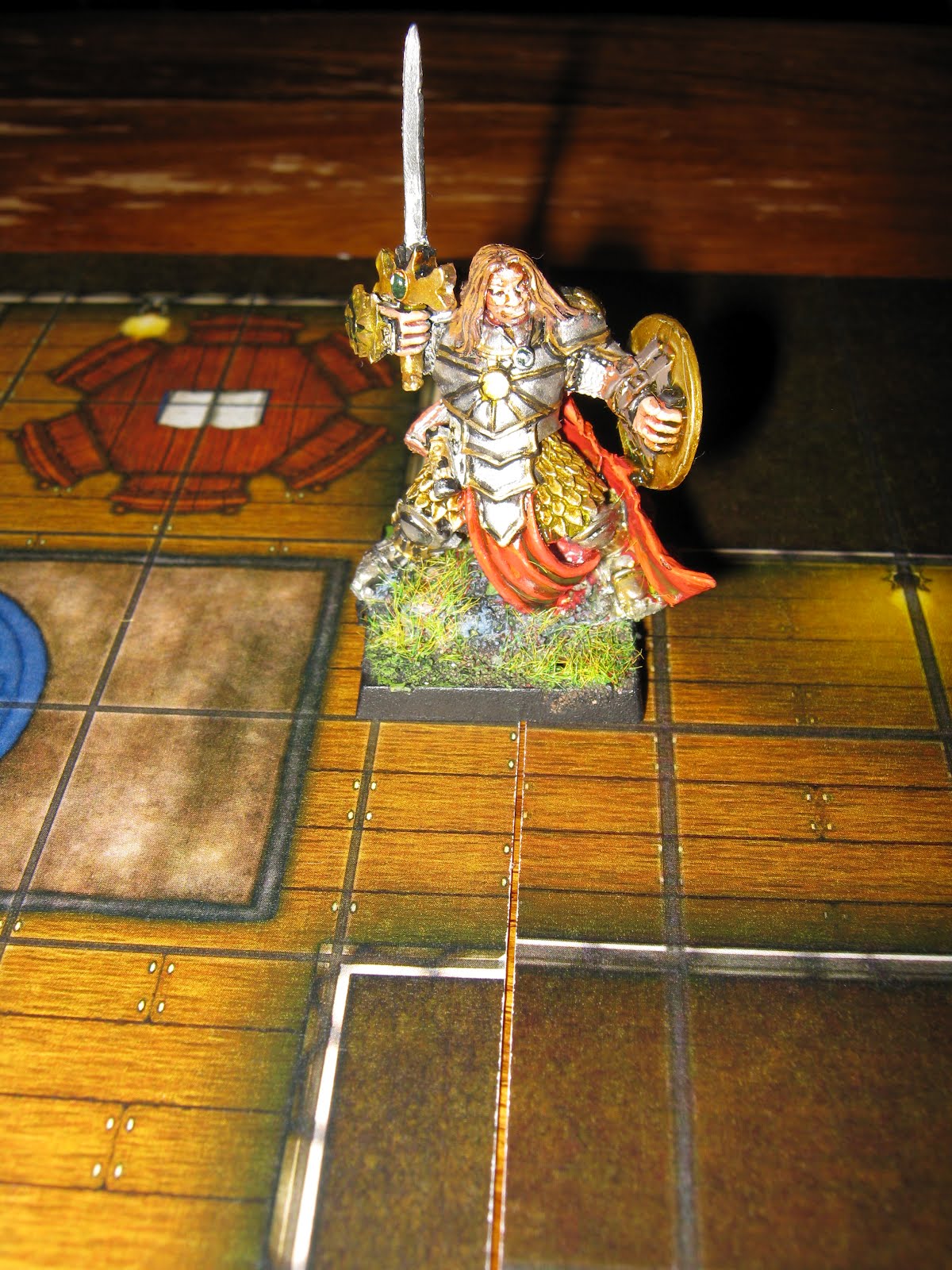
Paladin
Why are they pirates?... because they Arr!

Monday, August 20, 2012

Once Upon a Time in Marienburg Map

This map contains all known locations in Marienburg the players have visited, as well as default locations.

Sunday, August 19, 2012

Warhammer Fantasy Roleplay: Once Upon a Time in Marienburg Part 2

Day 5 (contd):


Returning to the Pelican's Perch tavern the companions retrieved their evidence and travelled to the Temple of Shallya to leave it in the care of the acolyte Getta. There Zhlak and Darok were treated for the sneezing they began to exhibit from floating in the canal during their misadventure with the monkey. The two were forced to wander around the city wearing pungent herbs in a pouch around their necks.

Back at the Perch the companions asked the barkeep about their assailant - the one legged man with the eyepatch and monkey, but before long turned their attention to the mysterious whaler Whitey that Max had told them about. Ishmael, the proprietor of the Perched Pelican, directed them to the White Dove, a ship that had been in dock for the past few days.

Directed to the captain, van der Valk, onboard the company asked if he knew where Whitey was. The captain said he did not know, and that Whitey had not signed on for the next voyage yet. He told them to look either in the Suiddock keghouses or ask Godymas, a priest of Manaan who tended a local whaler shrine nearby. He warned them not to offend the priest as he was well-thought of in the local community.

At the whaler shrine the group met Godymas and he told them he knew of Whitey, but not of his whereabouts. In exchange for a few guilders the priest mentioned they should speak to another crewman, Chekov, who was in a house of ill-reputed called Beatrice's, and Voger, who was indulging in the Black Lotus at Ho Kong's den.

As the company travelled to Beatrice's they witnessed a docker being attacked by thugs. When challenged the thugs told the company they were on guild business. Never the less Zhalok and Mellisandra wounded one of the thugs while Dharok covered the other in canal mud. After the thugs withdrew, vowing vengeance, they learned the docker, Rip Otter, was being threatened for working on the docks without being a member of the Stevedore's guild - yet another example of Marienburg's laws that favoured the multitude of guilds. Zhalok feared they had made yet another powerful enemy within the city.

Beatrice's was a terrible bawdy house and its sawdust floors and stench of tobacco offended the companion's senses. The caked-makeup of its madame did little to disguise the multitude of bruises on her face, and the clientele comprised of sailors and unsavoury types. Dhalok left in disgust after an initial inquiry into the whereabouts of Chekov was met with jeers. Only when Melissandra offered 10 guilders did Chekov reveal himself.

The man, a Kislevite, spat with disgust at Whitey's name and said he was not friend of that kossak. He said all the sailors were gathering for a cock-fight on a ship called the Salderbeam that night, but also warned Melissandra off the man, telling of how he had been found adrift in the Sea of Claws by the White Dove and had no memory of his past life.

The trio then travelled to Ho Kong's den, perhaps the least salubrious of Riddra's Black Lotus dens. Only after paying 5 guilders to enter did the Nipponese folk allow the company into the den, and the stench of the smoke overwrought Melissandra's elven sense of smell, lightening her head. Within the dregs of humanity that lined the berths and floorboards of the den Zhlak noticed even one of his kinsfolk partaking in the Black Lotus.

Finding Voger was not as hard as finding Chekov - the man, giddy on the lotus readily identified himself and spoke with him, though often he lamented about a comrade called Jake, and seemed to find it hard to focus. He said he thought Whitey was staying with his friend and fellow whaler, Terather, or Lady Veil.

Enquiries around the Suiddock lead the companions to Terather's house - she was well known being an oddity, a woman whaler - believed to be an elf, who dressed all in black and wore a veil. Knocking on the door the trio tried to pretend that they knew Whitey, and that Melissandra was called Ella. Though the veiled elf saw through the ruse she opened her door to them and they were greeted by Lady Veil in her full mourning regalia. With some trepidation they entered the woman's darkened parlour where she offered them tea while she regarded them peculiarly - Dhalok especially.

While Dhalok tried to sense for magic the dwarf and elf spoke to Terather, who evaded their questions about her veil, her profession as a whaler and elven ancestry with platitudes. She spoke of Whitey sympathetically, claiming she recognised him as a kindred spirit, a damaged person, and that she permitted him to take a room in her house. He was away, and was often away from the house.

She told them a tale of when Whitey had been lost on a whaler's boat, and when she pulled him from the water he said, "I can't find them. They are gone ... must find ... the Guilder ... Stein." and that in his sleep

The company idled away two hours with Lady Veil but eventually they decided Whitey was not coming home and they wished to go to the Salderbeam to seek him out. After wasting several hours in a dockside keghouse the trio saw scores of seamen boarding the Salderbeam. A queue began to develop as two dockmen took coins off each seaman and let them aboard the vessel. After a while Melissandra used her feminine whiles to arrange the trio to be allowed to cut in front of the queue. This infuriated a boorish drunk that was in the queue behind the company.

Later the trio split and mingled amongst the crowd. While Melissandra and Zhlak grew despondent that there was no sign of Whitey amongst the seamen Dharok found his luck was in on betting on the cockfighting and after a tip from one of the sailors he made a small amount of coin. He again ran into the boorish drunk who started to fight with him.

A circle formed around the two combatants and the sailors began to take bets. Dharok swiftly beat the man with his stave and left the fellow vomiting up the contents of his stomach on the deck. He was congratulated by several seamen, including one called Wilheim who introduced himself and invited Dharok to share a mug of rum.

The two discussed Whitey and Wilheim revealed he too was a crewman on the White Dove, and was a friend of Whiteys. Whitey was not in attendance this evening as there had been an incident on the docks this afternoon that had upset him - a beggar in a ragged coat of the Pilot and Seaman's guild had approached them and had knelt before Whitey begging forgiveness. The fellow was as bald as a coot and was missing two fingers, but Wilheim swore he wore a Holy Olovad medallion identifying him as a pilot who had fallen on bad times. Whoever he was, his presence had soured Whitey's mood. He had returned to his lodgings in a foul mood.

Flush with his success and the congratulations of the seamen Dhalok returned to his companions. In the morning they would return to Lady Veil's dark residence.

Day 6:


After a Pelican breakfast the three set out to Lady Veils and were granted admission. While Dhalok finally penetrated the mysterious energies of Terather's magical accoutrements and talked with the elf about magical training, Melissandra and Zhlak found Whitey in the kitchen preparing a breakfast of eggs. He did not recognise Melissandra from their encounter in Messtag and seemed reluctant to talk to them, even when she tried to introduce herself as Ella.

Whitey seemed almost disinterested in learning about his past life and when Dhalok pointed out his wedding ring he looked at it as if it were the first time he had seen it. Whitey struggled to remove the band and only judicious applications of grease by Melissandra were they able to remove it. Dhalok noted a maker's mark on the ring.

The three left Lady Veil's residence. Dhalok left for the Pelican to ask about someone named Guilderstein. Ishmael, the ever knowledgable barkeep, told him it was not a person but a van Onderzoeker vessel that had sank 3 years ago. He said the Port Authorities might be able to tell them more.

Meanwhile Melissandra and Zhalok travelled to Winkelmarkt to seek a jeweller. The jeweller identified the mark as being that of Stew Underson, a halfling who lived nearby. They decanted to Underson's house, an elderly halfling who offered them food and weed, whilst ensuring he took great quantities of both. He remembered he had made the ring 7 years ago for a wedding, and that the mark identified it as a Verenan wedding ring.

The trio left to go to the Temple of Verena, where for a handful of guilders earned them access to the marriage records. Alas without a surname they realised there were 30 Ellas. They tried a handful but none of the residents answered to Ella, and some of the addresses were empty.

As the day drew to a close the company returned to the Perched Pelican. As they walked along the docks a drunk bumped into them. They recognised the drunk as Max, and he whispered killers were following them. Sure enough two men were following them and after making certain they were being shadowed the party fended them off by threatening them with their weapons.

Day 7:


The group went to the port authorities where they learned from an unhelpful clerk that the Guilderstein was an old decrepit vessel belonging to House van Onderzoeker that sank with all hands and cargo enroute to Bibali three years ago. The date of departure was the same day as the White Dove. The House of Fooger had been obliged to pay the van Onderzoekers an extensive insurance claim. A second clerk was unable to find the detailed file on the Guilderstein - the files being removed by a clerk named Gheist that no-one seemed to know.

The group discussed what to do and returned to Godymas to ask about the Guilderstein. The elderly mariner-cleric said the captain of that ill-fated vessel was one Claude Bresson, who had owed many debts to the van Onderzoekers. He knew the captain had a widow, Ursula, and that a former mate on the vessel, Tanner, was still at large in the Suiddock.

As they left, the priest's voice echoed as he recited a poem, "That ship was there when I visited the Raven's realm. I saw it sailed his seas."

The company found Tanner drinking in the Pelican, where he cursed his lot, for he was now a stevedore - having been unable to secure a post on another ship. He confirmed the Captain owed the van Onderzoekers a lot of money, and stated the ship occassionally carried prisoners - prisoners that often disappeared after a few ports. As a mate he could not be certain - perhaps they were sold as slaves in ports like Bilbali. Occassionally from the hold he had heard children's voices. He was glad the Guilderstein was gone - he was certain the van Haagens had sunk the Guilderstein.

Hearing the name van Haagen again Zhlak frowned - was it the van Haagens that were behind this whole affair?

To be continued...

Friday, July 20, 2012

Warhammer Fantasy Roleplay: Once Upon a Time in Marienburg Part 1

Session report from 14th July session at East Midlands Roleplaying Gaming Group, Brunswick Inn, Derby

Dramatus Personae:

Darok the Almost All-Seeing: A tall Kislevite expatriate with a gift for augury and divination. Little is known about Darok, but he hails from the north-east of Kislev, where the winds of Chaos blow strong. (Human Kislevite Male Seer)

Zhazhicl Dizmad Hirn (Zhlak): A hardy and itinerant dwarf who makes his living fighting for coin in the pits of manlings. As with so many of his kin he does not suffer fools and has a long memory for grudges. (Dwarf Male Pit Fighter)

Mellissandra: A high elven archer fresh off the boat from Ulthuan, seeking the sights of the city that now stands upon the elven outpost of Sith Rionnasc'namishathir. (High Elf Female Hunter)

 "An act of violence is never solitary. Its ripples affect all around it and nothing is as it was before."

As the sun rose over the canals of Marienburg the local fishermen waved, as was their habit, to the crew of The White Dove as it gently approached the Suiddock docks, its hold overflowing with cargo. On board the man once known as Marius Steinfield, looked at a city he did not remember. Little did he realise his return would set wheels in motion. Woe betide those poor fools crushed under those wheels.

Day 1

The dwarf Zhlak was taking his ease at a cafe by a small unnamed square in Marienburg's Winkelmarkt, while Darok hawked his divinations to unheeding passersby. The two fell into conversation and over ales Darok decided he woudl jump into the nearby fountain to retrieve a brass penny - the only coin his toils so far had brought them. Mellissandra, a young high-elf archer newly arrived from Ulthuan, seeking the sights of the Elf District, observed the unusual pair.
As Darok emerged with his prize an out of control wagon nearly smashed into the fountain. He had to dive out the way to avoid being crushed. The driver fled from the wagon, driven off by men on the back of the wagon in common garb. A second wagon drew up beside and the men proceeded, at the behest of their leader, to rummage through all the wagon's crates, discarding all the mundane trade goods contained within.
Curious Darok attuned his gift to sense magic on the wagon and the leader, Ostav, asked what he was doing. When Darok finally explained Ostav told him to redouble his efforts, but the Kislevite seer could sense no dweomers eminating from the wagon. Zhlak in the meantime helped himself to a bottle of ale from the discarded goods, but his timing could not be worse as it was then that a score of Marieburg's watch, the Black Caps, descended upon the square. Ostav's men fled, but Ostav was too determined to make certain that Darok detected no magic on the wagon that he was left flat-footed.
The three were arrested, with the hapless Kislevite and dwarf assumed to be Ostav's men. They argued for a while before the Black Caps Captain ordered them forcibly manacled. The elf, when questioned, stated she had witnessed little of use. This was enough for the leader of the Black Caps to order her arrest as well.  It then became apparent the Black Caps would tolerate no mischief and were using an excessive amount of force and amount of manpower to bring Ostav to heel.
The four were taken by wagon to the Winkelmarkt watch station and then placed in a cell, still manacled. Zhlak continued to berate the watchmen, which earned both him and the silent Ostav a beating. After they were gone the strangely serene Ostav tried to reassure the fellows that all would be well, but Zhlak was not convinced.
The next day, still manacled, the quartet were taken by river to the Central Court in Paleisbuurt (Palace District). They were led to the courtroom by the Black Caps and sat while other trivial cases were dealt with by the attending magistrate, one Kai der Kwick. When it came to their turn the group Zhlak insisted on defending himself, until he learned that by quirk of Marienburg's law all those who defend themselves automatically lose their case (a law which Marienburg's legal profession approve of). However their lawyer seemed strangely passive, and as they learned the charges against Ostav and his band included assault and robbery upon numerous major houses of Marienburg Zhlak began to suspect why the wheels of Marienburg's justice were turning so quickly on this morning.
The trio availed themselves of the opportunity to speak in their own defence (though the Black Cap captain weighed in at every turn to counter their statements), with Melissandra's status as an elf being recognised by the magistrate. As her alleged crimes had not occured in Elftown she was subject to Marienburg's secular law but the magistrate agreed to postpone sentencing for her. For the others though he began to pronounce sentence until a court clerk entered and handed him a letter. After a moment the litigant declared the group not guilty, that it had been a terrible mixup. This enraged the Black Caps but they were removed from court. The group, Ostav included left the court room free men.
Ostav apologised for recent events, though it was clear this was not enough for most of the group, Zhlak most of all. When his belongings were returned he gave the company 3 guilders as recompense. After promising to make it up to them later the group let the mysterious fellow leave and moved to a nearby expensive inn to dine at Ostav's expense. Later they went to a boarding house recommended by Ostav and found the rates quite agreeable.
Darok later went out to a nearby alehouse by himself. Speaking to a trader from the Suiddock's Import-Export Exchange he learned the rumour that Ostav and his men had been found innocent at their trial because Ostav was either the son or nephew of Director van Haagen, the Haagens being of Marienburg's Ten Families.

Day 2

Before breakfast the company received a message, delivered to their lodgings by a young boy, inviting them to a house in Goudberg. Upon arriving there and being shown in they realised the man before them was Kai der Kwick, the magistrate from the day before. The magistrate said he had been impressed by the way the company had handled themselves in the trial and that he wished them to deliver a message to a person in the Suiddock. He impressed on them that this was a matter requiring both discretion (hence the seer and elf) and forcefulness (hence the dwarf) on the part of the deliverers - and paid them 10 guilders each. The message was a bag containing 50 guilders, and a strong assurance this was the last such payment.Following Kwick's instructions the company returned to Suiddock to an abandoned shop. A pair of thugs opened the door to them and they met Leon Reno and delivered the money and message. Reno told the fellows his response was, "The details are elsewhere" though he was clearly shaken by Zhlak's attempts to intimidate him.
Returning the group stopped by the Bruenwaser Kanal as Darok spotted a striking woman weeping by the canalside. Her brown tress of hair and facial features resembled their elven companion, Mellissandra, though the elf claimed she could see no such likeness. She gifted the elf a necklace made of shells, a good luck token she claimed, before departing. Darok could sense minor magics of life and death in the necklace.
Arriving once more at der Kwick's townhouse the trio saw a window on the third floor was opened, and heard a loud smash. When no-one came to answer the door the three of them forced their way in and ran up to the third floor. The bedroom where the window was on was deserted, save for part of a smashed vase.
Going downstairs the three found one room locked and forced the door open to reveal a small library with a dead woman lying upon the floor. Mellissandra noted an acrid sweet smell. Searching the room the trio noted books on the New World and Lustria, and on the desk papers containing poetry to the Goddess of Mercy, Shallya. An empty snuff box and an unopened box of sweetmeats also lay on the desk, and by the panels of the desk the fellows found a green cylindrical pod-like item. Mellissandra secured it upon her person just in time, for a group of Black Caps burst into the house with the magistrate.
Seemingly devastated by the death of his wife, Hanna, the magistrate acknowledged the trio as his men and that he had been expecting their return. He mentioned he had just returned from errands and had seen a dark figure sneaking about the upper floor through the open bedroom window. He had run to get help, little realising his wife was in the house. Finding no marks on the body, and after a lengthy interview with the fellows the Black Caps believed she had locked herself in the library and proceeded to die of fright as the looters ransacked the townhouse.
Bemused the trio returned to their lodgings to let their employer grieve. 

Day 3

The companions spent the day performing basic chores and making purchases with their new-found wealth. Darok identified the mysterious pod they had found at the magistrate's room as a cocoon. The companions decided to avail themselves of the library of the Temple of Verena in Templewjik. However Zhlak and Darok could not read and soon grew impatient. As Ostav had promised to contact them at their boarding house Zhlak sent a messenger to the Haagens.Mellisandra's efforts proved fruitful - she identified the cocoon as belonging to the Lustrian Tiger Spider. The description was, however, rather incomplete, and the other tomes in the library were written in the ancient Classical of Tilea.

Day 4

At breakfast the companions received a letter, stating:-My friends,
Please meet me at Deedesvald Graveyard this morning at ten. It is of the utmost urgency.
Yours in hope,
Getta


Going to the cemetery the companions witnessed Hanna's funeral attended by many of the good and great of Marienburg, including numerous priests and priestesses of Shallya. They also saw Kai der Kwick, his maid Celeste and by her side the odious Luc Reno they had delivered the message to.
After the funeral Gretta made herself known. She was an initiate of Shallya and in hushed tones, concealed by the morning mists she told the company of Hanna's unhappy marriage to Kai, of how he beat her and how she had only found happiness in her work with the Church of Shallya. She was certain Kai had arranged for her murder, despite the lack of evidence. She implored the company to investigate. They agreed, though they were uncertain how they could help.
Going to the Elftown the trio made the acquaintance of Fiaroth, one of the apprentices that worked in the chaotic emporium. There they enquired about the tiger spider, including offering to sell it to the apprentice. The apprentice knew little about the spider (referring them to the Southlands Expedition Company, who had acquired the spider for the shop). Their attempts to sell the spider back were rebuffed when he said it was a niche market and that there was little demand for one – the last one had been ordered over a year ago and had just arrived from Lustria a few weeks ago. He, and a nearby dogsbody called Antonio, described the buyer as an Estalian called Heraldo Garcia.
In Messtag, the violent Estalian district of Marienburg, the trio learned Garcia could be found later than night in a brothel. To pass the time they returned to the Magistrate's mansion ostensibly for their pay. Mellisandra excused herself and was escorted to the facilities by the maid, Celeste. She noted the maid was wearing a set of expensive pearls. After she left the room she returned to the library. Searching it quickly she found nothing of import, but this time the books on the New World struck a chord with Mellissandra and she quickly found a reference to the Tiger Spider.
After receiving their pay and being told by Kai der Kwick their services would not be needed any further the group the group returned to the brothel. There they quickly found Garcia and cornered him. A sailor approached Mellissandra and accosted her, calling her Ella. Apologising the drunken sailor left with his comrades but not before Garcia tried to make a run for it. Darok restrained the Estalian and after renting a side-room they interrogated the Estalian, learning he had acquired the spider from the shop on behalf of an anonymous benefactor who had arranged for some ‘business trouble’ to disappear without charges. Through one of Messtag’s numerous local crime gangs, the Ramones, he had delivered the spiders through a series of anonymous contacts.
The group returned to the Suiddock and while returning to their lodgings were approached by a one-legged man with a monkey on his shoulder. He persuaded the group to join him on his barge, saying he had orders to take them to someone who had information for them. Zhlak had his reservations but they agreed. As he gently rowed the barge up the canal the man lit his pipe with a piece of paper and handed the burning paper to his monkey companion. The monkey ran below the barge. Then as they passed under the bridge a rope was lowered to the one-legged man and he clambered up it swiftly, pulled up by shadowy figures on the bridge. Mellisandra was the first to hear the hiss of a fuse and as Zhlak tried to push the barge a voice yelled for them to jump.
Mellisandra vaulted effortlessly into the canal water but began to flounder, while Darok leapt after her. Zhlak barely cleared the barge as it blew, but his armour protected him from the debris. Darok however was not so lucky and took some scrapes and cuts. The dwarf and elf struggled to swim but Darok used the debris that had buffeted him to get to shore and threw a rope to them.
All three were wet and miserable by the time they returned to their lodgings, but they spied a mob of black caps ostensibly searching the boarding house for three Chaos worshippers. The three decided to decant to a different hostelry, choosing the Perched Pelican, a nearby tavern. There they quickly made the acquaintance of the titular pelican, Beaky, and decided to drink to warm themselves and drive the taste of the filthy Suiddock away with copious amounts of alcohol.
As they were recovering from their ordeal a man approached them in a black cloak, introducing himself as Max. He stated he was the one who had warned them on the bridge. He told them that they had made powerful enemies in Marienburg, forces he wished to help them oppose. He told them that he knew they were a friend of the whaler Whitey and wanted to silence all of them. If they wanted to be safe they had either better travel to the New World or look into Whitey. After some questions he left the companions to their new lodgings.
The company discussed what to be done. They assumed it was Kai der Kwick who had tried to have them killed. He would have to be dealt with.

Day 5:

At breakfast the companions decided to leave the spider cocoon and a letter to the watch explaining how Hanna der Kwick had died with the barkeep, with instructions to take it to the Black Caps if they did not return. When they confronted the magistrate and mentioned that proof would find its way to the watch he first of all tried to blow-off their allegations. Finally he admitted to the murder, but stated no-one would believe them, and that he had not tried to kill them. He brought the companions the contents of his safe, 150 golden guilders and made the dwarf swear that they were finally done with each other.Flushed with success the companions returned to the Perched Pelican and decided that they would take their evidence to Getta at the Temple of Shallya. However if Kai der Kwick was telling the truth and was not behind the attempted murder, who was?
To be continued in August

Quote of the session
Naomi/Mellisandra: (looks bemused) “I don’t know how I feel about monkeys carrying fire.”


Saturday, May 26, 2012

Two Good WFRP2 Fan Sourcebooks

I'm normally not a fan of fan-material (except the Oerth Journal for Greyhawk which is brilliant) but as WFRP is effectively out of print except for 3rd Edition (which has its issues and is overdue a long review but suffice it to say is effectively a new game) it's worth pointing out 2 unofficial sourcebooks for WFRP2E.


Warpstone Issue 25 was entitled Fimir: Ruinious Inheritence and is essentially is a WFRP2E sourcebook for the one-eyed rapists (Fimir cannot reproduce amongst themselves and have to abduct human females) that were quietly dropped from Games Workshop's line in the early 90s due to being too 'risque'. Probably due to the whole rape thing.

This is quite an interesting sourcebook, though it could be more professionally laid-out and less chatty. I've had a bit of a soft-spot for these guys in Heroquest, but they've all but disappeared now. The last scenario they appeared in was in the 90s and to be honest it would make a nice change from skaven being behind everything for them to crop up in an official scenario. As an aside, I'd love some bog-raider substitute minis (see left).
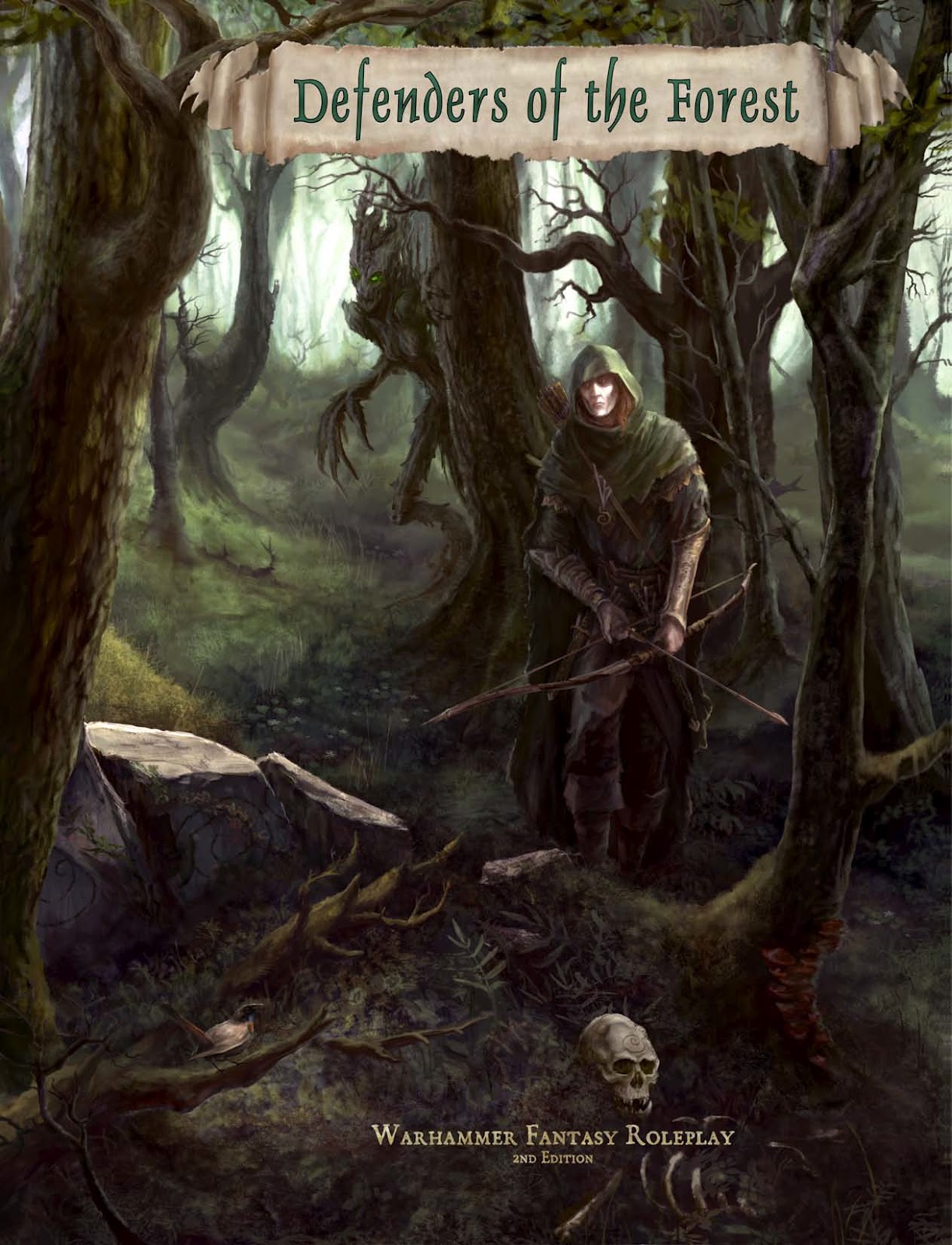

Defenders of the Forest came out today and is an unofficial but complete WFRP2E sourcebook for Wood Elves. This was a long overdue publication as an awful lot of the Bretonnian/Athel Loren connection was intended to be followed up in the elf sourcebook. You can get it here.

Elves have had a pretty rough time in WFRP with no source book to speak of. Dwarfs have a 3E book, as well as the excellent Dwarfs: Stone and Steel. It's a strange thing. A lot of people play wood elves as racist thugs who inexplicably travel through human territory despite hating humans. I'd see them more as the kind of fey types who could slaughter a village for logging but burst into manly tears because someone stood on a daffodil.

Previous WFRP editions assumed your elf PC was an 'urban' elf who was in some way assimilated into Imperial society, while WFRP 3E offers startup careers such as Wardancer that seem much more 'high-fantasy' than a human ratcatcher or road warden.

Wardancers are included in Defenders of the Forest but are not a basic career, an immensely good idea. The Kithband warrior career from the Core rulebook is and allows one to advance into Wardancer - a career I'd never noticed was missing from WFRP2E. Interestingly they get some magic advances (probably a typo).

I also rather like the fact that there is basically detailed gazetteers of the Wood Elf enclaves, allowing parties to actually explore Wood Elf territory, rather than having wood elf PCs trapse around the Empire stating how much they hate humans. Amusingly under the new rules wood elves also gain insanity points for extended periods away from the forests (1 point per month if they fail a will power test) that can lead to them being unable to return to their homeland permanently.

Tuesday, May 01, 2012

Sotturm Finished

Here it is - the finished map of Sotturm, a town in Middenland for Warhammer Fantasy Roleplay complete with hi-res download here.

Finished Sotturm Map.


Map key is as follows:-

S1. The Count's Holdings
S2. Wolf Pack Tavern
S3. The Garrison
S4. The Temple of Ulric
S5. Garden of Morr
S6. Temple of Sigmar
S7. Shrine to Taal

Monday, April 30, 2012

Warhammer: The Red Duke

The Red Duke was a book I was in two minds about reading but I must say it is without a doubt the best book on Bretonnia I've read. It has dueling families, honour, moral dilemmas and interesting protagonists as well as a bat-guano crazy vampire as the main character who has none of your emo-semi-human vampire struggling to keep his humanity nonsense.

I refer to the titular Red Duke, a famed Bretonnian knight who returned from the crusades in Araby (subtle) as a vampire lord and laid waste to the Duchy of Aquitaine. He was eventually killed but his remains were interred and he regenerated but found himself entombed. This drove him quite mad and the author gets quite a lot of mileage by having the vampire flash back to various parts of his past.

There is actually a lot of potential information for WFRP Bretonnian campaigns (the Duke is mentioned in the vampire sourcebook Night's Dark Masters, though gets little mention in the Bretonnia sourcebook). The storyline is vased off the WFB "Circle of Blood" battle campaign which placed Bretonnian player against a Vampire player. It does lend credence to the old adage that WFB is the propaganda of the Old World, as while the story does follow Circle of Blood's outline to a certain extent it is not afraid to deviate from it. For instance the first part of the campaign is a battle in the village of Mercal between the undead and a rabble of peasants led by the Holy Knight, a respected knight of the realm. In the novel this still happens, but instead the Holy Knight is a failed questing knight who is now a templar of the death god Morr (Knights of Morr are something Werner seems to like, they crop up in his tales regularly) and his warnings to the arrogant nobility are ignored. This chap is get (the Warhammer term for siring a vampire, not a grammatical error) by the Red Duke and later becomes the titular Dark Knight who serves as his general later on in the story.

The 'shiny' Bretonnian honour system takes a bit of a bashing in this story. There are no heroic Grail Knights (except perhaps for the King Louis the Righteous of Bretonnia, the king during the Duke's first rampage). There is a significant amount of the novel devoted to Grail Prophetesses of a local landmark called the Tower of Wizardry (rules for which are on my webpage, plug plug). Knights of the Realm are content to quarrel amongst themselves. The three main knightly protagonists are divided by infighting and seem unable to unite to fight against this great evil, and it is this infighting that allows the Duke to escape his tomb. Even Louis the Righteous and his immediate vassals aren't quite as righteous as advertised!

One learns a lot about the Red Duke in this book, which is great considering he was a bit of a one-note villain in "Circle of Blood". There's little need for detailed motivations for villains in the battle game. We learn that he was the rightful Duke of Aquitaine and the king's brother, that he was get by one of the Old World's most powerful Blood Dragon vampires and that before he was turned he was such a frightening warrior he was named El Syf (in Araby literally the Sword). We learn of how certain parties tried to usurp him. It's all good stuff - the book does jump around from time period to time period though the thrust of the main narrative is the tale of "Circle of Blood".

There's some nags. It's too short in my view and I would love to have seen it carry on past the climactic battle. The nature of this story (having to leave the Duke alive) is that there is no real satisfying conclusion - though a sequel novel set in Warhammer's present could rectify this. I wouldn't hold your breath though, this is part of a series of one-off tales. The 'twist' conclusion to the main story regarding the Duke's bloodline came out of nowhere and left me utterly confused. Overall though well worth checking out, and some potential to be mined for a WFRP campaign in Aquitaine. Coincidentally one I've already discussed...

Tuesday, April 17, 2012

Bretonnians at the Student Nationals 2012

So at the weekend I ran two sets of victims through my demented WFRP2E adventure. You can see what I am talking about at this micro-site. Maps, character sheets and the first 2 pages of the scenario are available.

This story was playtested by Naomi, Len, Josh, Fake-Charlie and Simon in Derby, who gave a lot of valuable feedback (mainly on tweaking the character sheets to avoid Death-By-Handouts and to be readable to a non-WFRP2E literate group of ne'er-do-wells). I did worry when we started around 3pm and finished around 2am, but we did faff quite a lot and my poor beloved Naomi got saddled with the female spellcaster with 6 pages of rules. The poor lass can still only count her RPG experiences on 2 hands. Coincidentally both tables at the con had exactly 1 girl and out of personal preference I preferred to give the girls the female character. I had a 2nd female character in case they wanted to play a fighty-type or we had more than 5 players, but Brunhilde the Norse Beserkeress was Lady Not-Appearing-in-this-Scenario both days.

The games themselves were a success. It was essentially a WFRP version of "The Quest for the Unholy Grail", chasing after a blasphemous Slaaneshi artifact that mimics and mocks the titular Grail of Bretonnia, with a white rabbit similar to the one-from-that-film. I've changed the scenario title about five times. It was set in Carcassone in Bretonnia, in an area called the Auveau Campagna. It was inspired by some of the Warhammer novels I've reviewed in earlier posts. Certainly the Knights of Bretonnia book and C.L. Werner's excellent Red Duke novel (read it on holiday, review forthcoming) were a big inspiration.

Some of the players on the second day commented that I'd made a lot of effort on the character sheets and character bios, though I think if your players pay over £100+ for accomodation, travel and convention fees they deserve a DM who didn't write the scenario on a beer-mat the night before. Both groups politely asked if they could keep their sheets and handouts, which was a nice compliment and I hope they like them.

Unlike in the playtest both days a character picked up an additional insanity. One the first day the Grail Witch picked up "Fire Bug" (i.e. pyromania) on encountering a ghost and failing a terror check. She roleplayed this reasonably well but sadly didn't burn down the inn the ghost was in.

On the second day brave Sir Tristan de Graal, Knight of the Grail, gained what was essentially depression on failing his terror check with the aforementioned ghost. Since he shortly afterwards learned from the ghost he would have to sacrifice his life to destroy the Unholy Grail it seemed kinda fitting he'd start to wish he was wrapped up in bed.

PC: "Why have you not done something about the ghost in your inn?"
Peasant: "Who am I going to call...Why did I just say that?"

While writing the scenario I thought it would be rubbish to have all 6-7 players playing knights in WFRP. Pendragon allows for diverse knights, but WFRP knights only differ in which munchkiny virtue talent they choose from Knights of the Grail. I then decided to add a herrimault (Robin Hood type peasant), but then make him outrageously over-the-top. Hence Caradas de Bergerac (Cyrano's little known cousin) was born. Probably he'll get retconned into de Berac to make it less obvious if I ever use that character again.

My favourite player was one who played Henchard, the Battle Pilgrim. Grail Pilgrims are basically weird groupies who follow Grail Knights around collecting discarded sundries to use as relics. This particular pilgrim was inspired by Baldrick in Blackadder: The Archbishop, and one player in particular relished wheeling and dealing in relics all the way through the scenario. As the only 'real' peasant in all 3 runs of the scenario I worried that this character might be a pain the arse to play as all the noble PCs had the license to torture him. This poor chap was reduced to riding on a donkey (the knight PCs suggested he be loaned a donkey, not a horse, even though the Duke of Carcassone was happy to lend him riding horse), but ultimately he wound up on the deal (as did the character in his other 2 incarnations).

Perhaps the most troublesome character was the Grail Witch. For some reason I cannot fathom Knights of the Grail does not allow PC Grail Witches (claiming they're too game-breaky with their prophetic skills) and a lot of the other careers like knight, yeoman etc. are 'male-only unless you play a woman pretending to be a man' and suggests this practice is very widespread!

Anyway, I found some rules for Grail Damsels and collated them into 1 pretty document. Thus Guenere de Chanel, Prophetess of the Grail, was born. My take on the Grail Damsels is roughly inspired by some of the sorceresses you *ahem* encounter in the Witcher 2 (a great CRPG you should check out BTW). All 3 lasses playing this character made pretty good use of her arsenal of spells - including the awesome Doom of Dol on the 2nd day with a pretty epic intonation of "Sir Luc du Besson, you will slay Sir Lancet d'Ouest."

One thing I will say was, the brief for the convention was to write an "Action & Adventure" scenario, and WFRP2E is not exactly the first system you think of (7th Sea is IMHO, or possibly Feng-Shui). However knights, dragons, damsels, explosions, fires and mutants all made it pretty action packed, although it was very high-fantasy (most PCs were in their 3rd or 4th careers and in the 2nd day in particular were bricking it during combats against mutated 1st-2nd career dudes).

I might return to Bretonnia one day. I've the idea for a low-fantasy campaign called "The Ballad of Derrevin Libre" which mixes resource allocation, Edgar Allen Poe, Arthurian knights and the French Revolution. Suffice it to say the PCs will be hedgefolk, peasants and servants, not knights of the realm.

(Artwork on this post and the sheets was Google Imaged without permission).

Monday, March 26, 2012

Stuff I Would Like to Run

The Student Nationals are coming up in a few weeks time and I am hastily prepping my scenario, Vessels. It's a Warhammer Fantasy Roleplay 2nd Edition scenario, and I will not say anymore about it for now, though I've some vague notion of publishing it on my site for posterity after the Nationals, along with some of the amusing PCs I created.

I ran a playtest of it this weekend in lieu of our regular WFRP 3E game and it was a lot of fun despite the fact only 1/2 the scenario was statted and written (though I was using monsters out the books, except in one case).

It overran dangerously, but our group is prone to much faffing and silliness. This session was no different, but there was significant character development for every PC, which is difficult to do in a one-off, as well as 3-4 combats - including one very memorable one where the missus managed to mind-control a very, very powerful monster in such a way as the other PCs made mince-meat of it.

The only real rub was we only had 5 players, and I had designed the scenario for 6-7, including hastily genning one of the PCs the night before.

This means I've been bitten by the DMing bug, and there are a couple of WFRP campaigns I've got real interested in running. Sadly my only outlet is our WFRP3E game, which is a lot fun, but lately I seem to count down the days til our next game. I do plan to do a review of the system here (it is a bizarre experimental hybrid of board/card game and RPG) but the following factors have prevented me:-

a) It'd be -very- long.
b) It'd be fairly negative, though I've thought of some positive things to say - most of the 3 WFRP3E scenarios I've played or read have seemed pretty good. The only real let-down was, ironically, the major campaign boxed set we played through, though it's not the first WFRP scenario to have those flaws.
c) I worry my DM might hit me with a stick as he has probably invested £200+ (seriously, this is not a cheap game) in buying most of Fantasy Flight Games's shiny but shallow boxed sets and has every right to feel defencive of the system.
d) I don't own it, beyond some pdfs I've pulled off the web.

In the mean time I've become quite keen on WFRP2E. In addition to my playtest I ran an old converted scenario, Night of Blood at one of the Derby meetups I actually managed to make. The system holds up quite well, and I've a hankering to run a proper campaign, though that may wait until I finally get a bigger place to live with a games room. But here they are:-

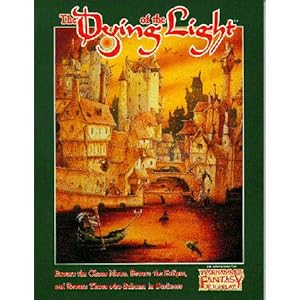
The Dying of the Light

Mine! Mine I say!
I won this module at the Student Nationals in the late 90s when it was held in Glasgow for being the team leader and for us coming 2nd/3rd/4th or something I've long since forgotten. I presume Hogshead provided the prize support. Since no-one else claimed it, it sat on my shelf for years until I started buying the WFRP2E line. It seems to have accumulated significant value on Ebay.

Tangent 1: Not that I plan to part with it - it's mine, MINE, and was probably the only thing I ever got, in lieu of actual gratitude for being DURPS president and organising the society's nationals trip at a time when I had no car, much less a sat-nav and the only driver in the club who'd give me a lift didn't know where Glasgow was. One fellow even wanted an impromptu election at the Nationals to take the post of president off me when it looked like we might actually win, which was gratitude for ya and cemented my "take a hike you ingrates" attitude towards any overtures to get me back on the committee. Anyway, rant over. I didn't feel bad about keeping the module.

This is actually a set of linked adventures by different authors set in Marienburg and the Wasteland, Warhammer's answer to Amsterdam and the Netherlands. It's an interesting scenario as it gives the DM a lot of free-reign in running the scenario. A lot of the text is very conversational, "You might want to do this... if they do this, consider having maguffin behave like X, Y or Z, depending on which you think is more interesting"

It's fairly short (probably it would take 3-4 months of weekly play), but relatively epic in scope. There's some weird goings on in Marienburg, some talk of an eclipse of the sun by the Chaos moon and the city being destroyed. The heroes are drafted in through a rather long prologue that tries to leave the "you meet a man in a bar and he hires you to do the scenario" cliche behind, but instead assumes you've given the PCs a hook to go look up an NPC... who begs them to do the scenario. I'd probably tinker with this - there's some good Marienburg stuff in Warpstone to kick off this campaign with.

There's some crazy stuff in this module. Very little of it is set in the city, it is mainly a wilderness trek with a few rural encounters and sinister apocolyptic tones. One long-banished Warhammer/Heroquest monster makes a welcome entry in a particularly apocolyptic chapter of the scenario that I'm amazed made it past Games Workshop's sanctioning nazis as not only does it feature these creatures but it references Malal, a chaos god that Games Workshop technically do not own copyright on.

Some of Dying of the Light's maguffins are a bit suspect. There's a NPC that certain more psychotic players will want to murder (and only vague suggested consequences for doing so). There's the old magic compass maguffin, basically leading the PCs by the nose. Aside from the fact the writers forgot the PCs might try to triangulate their intended destination it suffers from the old RPG trope of being told "this trail/map/ is the safest route to your destination" and discovering it leads you through a series of suspiciously planned encounters and ambushes. It's pretty easy to fix that plothole in the scenario though.

Another downside is that it is a WFRP1E supplement (although 1E and 2E are pretty easy to convert on the fly. Don't get me started about 3E though!). Perhaps the last disappointment is this is for 2nd career characters. In WFRP you often start with a random and often pretty lame career - such as Rat Catcher or Servant (though WFRP2E wittled this away by making most careers fairly combat-orientated, nobles were no longer fops but deadly fencers, and WFRP3E starting characters are all superpowered gurus). Your 2nd career is typically chosen by you and is a more "adventurer" career. It's also typically when you finally get spells if you are a priest, or decent spells if you are a wizard.

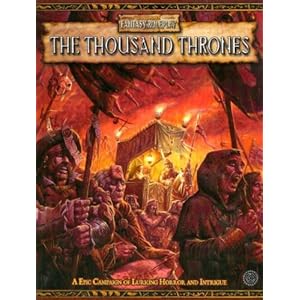
The Thousand Thrones

The rather spiffy cover is actually a pretty major spoiler.
The Thousand Thrones is an epic, sprawling beast of a campaign taking PCs from Marienburg into the Empire, and eventually into the distant north. It was designed to use a lot of the WFRP 2nd Edition sourcebooks, such as the Kislev sourcebook. In many ways it is the WFRP 2nd Edition to the Enemy Within - although this is one book with numerous web-enhancements, rather than a series of books.

Set shortly after the Storm of Chaos (a large wargame event that saw Chaos overwhelm the north of the Empire and a possible reincarnation of the Emperor-God Sigmar managed to defeat its leader at the cost of his own life) this is one of the few Warhammer 2nd Edition scenarios that actively builds upon the events of that campaign rather than generically paying lip-service as part of Games Workshop's edicts at the time.

Tangent: It's worth noting the designers of WFRP suggested they make the rulebook setting neutral (i.e. pre-Storm of Chaos) and release books and adventures to handle the Storm of Chaos. Lead designer Chris Pramas suggested options for letting you play before the Storm, one during and one in the Age of the Three Emperors, but no, Games Workshop knows best. Incidentally the new WFRP is set before the Storm of Chaos.

A possible new incarnation of Sigmar has come to prominence, and has been blessed by the exiled Grand Theogonist Esmer. The PCs must chase after this charismatic avatar, leading to all sorts of interesting scenarios. It's a complete 256-page campaign crammed with information (the font size is criminally small) that could easily take a year or so to play through (though the campaign could end earlier depending on player decisions). I mananged to get it for about £15 on Ebay so I'm giggling.

In many ways it calls back to Dying of the Light. It is written by several authors and each chapter is a mini-scenario in itself. It begins in Marienburg but sends the PCs away chasing a maguffin fairly early on. It is probably best not played by ultra-lawful characters (no zealots, witch hunters and fire-brand wielding priests of Sigmar) as some of the maguffins involve working with Chaos infected characters.

There is a good mix of investigation and combat, though I'm only really familiar with the first half of the campaign. The ending of the campaign is notoriously rotten, resembling a player-killer dungeon crawl. Also like Dying of the Light the beginning scenario assumes the PCs are somehow already involved in events and does not provide more than basic hooks to get the PCs involved in the scenario - it is largely left up to the Dungeon Master and the player to play ball.

I listened to this being played on the RPGMP3 website. This is run by an exasparated Brit expatriate and played by a group dominated by Texans who sound like Yosemite Sam and really, really struggle with the more intellectual and investigative aspects of the scenario. Worryingly they remind me of when I was 17 and 'trying' to play Call of Cthulhu. It also highlights to me why the DM must have razor sharp adamantium hooks to ensure the PCs remain motivated to investigate the maguffin of the scenario.

This is not a ready to run campaign on its own, unlike earlier WFRP 2nd Edition scenarios. The Thousand Thrones as provided is a reasonably interesting campaign but significant tinkering is required to keep it on track, particularly if the characters go off track.

There is substantial online support and advice on tinkering. One of the authors, Jude Hornburg, has released several online supplements for it and it's nice to see as some WFRP 2nd Edition felt a bit 'churned out' by freelancers (like the ubiquitous Robert J. Schwalb, who wrote many of the more so-so supplements as well as the much criticised end to this scenario. Though to be fair he is credited with also coming up with the interesting central concept). Jude's latest effort will include an introductory scenario that actually gives the PCs hooks to follow the rest of the campaign.

Own Stuff

For a while I've been tossing around a WFRP2E campaign idea I came up with called "The Ruinous Powers That Be" when overdosing on George RR Martin stuff. I've actually written most of the first scenario up as a full PDF, with the second scenario being . At once point I considered making the 2nd scenario my Nationals scenario, but as the category I'm running in is "Action" chasing drug-dealers and phantoms around the hills didn't really seem classically action enough.

The other campaign idea I've been tossing around is a Bretonnian campaign where the PCs all play downtrodden peasants, based on Graeme MacNeill's story, Freedom’s Home or Glory’s Grave with a smattering of Robin of Sherwood, Edgar Allen Poe and the French revolution thrown in.

Friday, March 02, 2012

Matthias Thulmann: Witch Hunter Review


Fresh after finishing Marks of Chaos, as part of my inevitable putting off of reading a Feast for Crows I read the Warhammer: Matthias Thumlann, Witch Hunter trilogy...

Way back in the dawn of time when I bought my Warhammer Fantasy Roleplay 2nd Edition book I was offered the first part for free. As it was the most WFRP-like novel on offer as part of this deal I accepted.

Matthias Thulmann could be taken out of the Witch Finder General movie with Vincent Price. His description certainly matches that of Price's Matthew Hopkins, and his often cruel mercenary sidekick Streng is a Warhammer version of Hopkin's sidekick Stearne. Werner, the author, is a big Robert E. Howard fan and in many ways he is also emulating Solomon Kane, a zealous Christian puritan swordsman hero, with his Thulmann stories. He has another character, Brunner, who sounds an awful lot like Robert E. Howard's Conan during his mercenary era.

The omnibus book has three short stories. The first of these is a run in with Chaos cultists that sets the scene nicely, the second is a medieval zombie survival horror story and the third is a witch hunt that links to the start of the first book. It seems a bit cheeky to make the last story interconnect with the first book - I read the book first and was confused by references to a seemingly non-existant set of adventures. This is how the character was first introduced and a continuity-freak like myself should not really complain.

The main story in the three volumes concerns Thulmann's search for an evil scientist (though the trail only picks up in Book 2) and various shennanigans pertaining to a sorcerer's spellbook. The book was stolen from a vampire and used by witch hunters for their own interesting purposes, but now a whole host of characters want the book back. One character, a villianous necromancer, is always in the background throughout the trilogy, but is never seen by the heroes.

Books 2 and 3 concern the book falling into the hands of the scientist and his skaven buddies. The skaven are written fairly menacingly, though I often feel they are overused in Warhammer. (Mind you this probably stems from when I started roleplaying with Advanced Heroquest. Skaven were the only monster you got in the box). I'd love to see a story or even a Warhammer adventure with fimir behind the nefarious goings on.

My problem with the continuance of the "get the book" arc throughout the novels is it starts to feel a bit old. Enemies are seemingly killed and come back with worrying regularity. At times it feels like watching a season of "Whacky Races" or "Stop the Pigeon". With Carrandini the Necromancer in the role of Dick Dastardly, usually ending the episode driving off a cliff and his car exploding yet emerging next week unscathed. Book 2 in particular does not stand on its own as a read - the ending is abrupt and a sizable amount of the third book is spent rounding off the second book and getting our heroes out of Wurtbad.

I would like to have seen Thulmann investigate a few new cases, perhaps some Chaos cultists in Altdorf or Marienburg. There is actually quite a lot of backstory of old cases hinted at in the story for Thulmann that I think would make for an interesting collection of short stories - and certainly more interesting than some parts of Book 2, which really dragged in places and yet also felt too short.

My favourite book is definitely the first one, though the third one picks up once our heroes leave Wurtbad, the setting of the 2nd novel. In Book 1 and the short stories our main characters are quite dark anti-heroes - Streng is an expert in torture and seems to enjoy his trade, Thulmann is happy to threaten his innkeeper to ensure he gets the best room in the tavern and the best food. He gets little help from the local lord, an ex-witch hunter, and there are conspiracies with conspiracies, including a nice little twist I didn't see coming.

In the second and third books the two main characters become more 'good'. Thulmann's high-handed and haughty manner to peasantry is explained (or dare I say retconned) as being an act - a necessary evil, as a witch hunter must be feared by the populace in order for him to function properly. Even Streng has some redeeming moments as he shows he might actually care about his employer and goes beyond what I would consider reasonable for a hired thug. Personally I was happy for the characters to stay very grey. They still do questionable acts, but compared to their peers it is pretty clear they are saints who go by the book.

This comes across a bit odd in the third book when they are teamed up with more zealous and self-interested members of the Church of Sigmar. There is the inevitable clash between the zealots and a group of peasants hiding a mutant child. Thulmann intercedes on the mutant's behalf, trying to stop the zealots from having a good old burning (almost a 180 from how I felt the character was initially portrayed) by saying they have more important things to do. Then later on in the book the villagers are revealed to be in league with the bad guys... making the zealots right in hindsight to want to burn the mutant. I personally thought that was a bit odd - but that's life I suppose. If they zealots have already gone to the bother of arranging a lynching why not just go through with it? (Mutants in Warhammer are a brilliant storytelling mechanism as ultimately there is something sympathetic about someone shunned in society through no real fault of their own).

As to the church there is some interesting politicking in the Church of Sigmar. Events from Marks of Chaos get a mention, as Gamow, the Lord Protector of the Templars of Sigmar (i.e. the head witch hunter) died in suspicious circumstances during the events of that novel. In this trilogy we learn that the Grand Theogonist Volkmar has decided to replace him with three new Witch Finder Generals, rather than give one man all the power. However the third book has Volkmar replaced as Grand Theogonist by Johann Esmer and Lord Bede about to be is installed as his Lord Protector. Apparently in the Warhammer Fantasy Roleplay books when Volkmar returns from the Storm of Chaos he brings back the three Witch Finder generals! Confusing!

The Grand Theogonist thread is part of the Storm of Chaos metaplot, and a bit jarring in this book as it doesn't really lead anywhere. This is probably the downside of a shared universe where the Storm of Chaos was intended to be a massive crossover event that affected even the novels. The new Lord Protector is to make the stories consistent with Marks of Chaos. The author goes to some pains - even Sister Karin from Marks of Chaos gets a brief mention in the third book, so extra marks for that.

Silja Markoff, a character introduced in the second book, is not a character I am keen on as she becomes the mascot for the "softening" our protagonists in the later books. She seems to be the quintessential 'generic adventurer' who is employed as an agent for her father, the Lord Justice of Wurtbad. This is a job that seems to leave her completely free of responsibilities (especially given what happens to Wurtbad in Books 2 & 3) and able to up sticks and follow our hero. She serves as the romantic interest, something that I find somewhat jarring when our main character should be a cold religious zealot. However if Werner kills her off in later books I'll give him a free pass on this - that would be an interesting twist and could send the character to a really dark place.

It's also worth noting the story ends on a cliffhanger after 3 books. The last book was published in 2007 and the author does plan to return to the series but says that we should not expect anything new for Thulmann imminently.

Overall it might seem I'm being critical of these books but they are a decent read. I hope to see more Thulmann.

Friday, February 10, 2012

Marks of Chaos Review


Marks of Chaos is a print-on-demand book available from the Black Library. It's also the first Warhammer novel I bought online. It comprises of two novels, Mark of Heresy and Mark of Damnation, as well as two short stories, No Rest for the Wicked and A Night Too Long.

The sole reason for me buying this is because I have long admired the author, James Wallis, for his work in the games industry. I was a big fan of his old company's (Hogshead Publishing) output for Warhammer Fantasy Roleplay as well as some of the other games he put out.

The man can write innovative games, such as The Extraordinary Adventures of Baron Munchausen - a game I can boast I have the Gentleman's Version (not the commoner's Wives and Servant's Edition). Sadly not all of his projects panned out - in the twilight times of Hogshead he was going to rewrite the original ending to the award winning Enemy Within campaign until a hard disc crash destroyed his draft and probably his will to start all over again (if only Dropbox was invented 15 years ago).

I have the original ending of Enemy Within - Empire in Flames and on paper it is a relatively good scenario. It's even got a fantastic mcguffin that I think players will enjoy, a fairly epic climax and epilogue that would satisfy any player characters that has slogged through the entire Enemy Within Campaign (and trust I only got as far as finishing running Shadows over Bogenhafen with some players who all-but-mutinied against the dark, dark plot.

Wallis stated his Empire in Chaos would be even better, and given Marks of Chaos I am willing to bet it would have been a really memorable climax. I'd also be glad I was the one sat behind the screen rather than playing as his novel puts the protagonist through the ringer and then some.

The story concerns Karl Hoche, a loyal lieutenant in the Imperial Army. Now at the start this sounds like bog-standard Warhammer but Karl very quickly finds some things are amiss in his unit and is unceremoniously parcelled off to Altdorf to report his findings to the regiment heads. It all goes south and Hoche ends up joining a secret branch of the Reiksguard called the Untersuchung (German for Analyse), a spy organisation that hunts Chaos within the Empire. It is the only way to stay safe from the regiment that want him dead to preserve their honour.

From this point on the novel shifts from the archetypical Warhammer fighty-fighty teen prose to a fairly tense spy-novel full of intrigue and nastiness. Hoche gets trained up in espionage and infiltration but realises pretty quickly that various factions within the Imperial forces are engaged in petty politicking against one another. For example the Witch Hunters view the Untersuchung as heretics. The Untersuchung view the Witch Hunters as unsubtle plods who would rather burn old ladies than do the legwork. Then there's the fact the Untersuchung is only part of the Imperial guard as a technicality, and that both they and the Witch Hunters have also been infiltrated by a group known as the Cloaked Brothers. This is a shadowy faction of ex-witch hunters content to observe Chaos and eventually defeat it by using that knowledge. So content they do not try to stop their plans.

This is also the same Warhammer as the Enemy Within campaign, so that means the upper echelons of Imperial society is compromised by Chaos cultists. The Powers that Be are just more likely to hinder or even actively kill our hero than help - either because they are cultists or because they are duped by their superiors who are cultists.

Plenty of cults abound in the book. The Purple Hand, a deep-cover cult and one of the main villains of the Enemy Within, make an appearance. So does the Ancient Order of Illuminated Readers in Marienburg, explaining what happened to them after James Wallis's (and plenty of other authors) own Marienburg-based Dying of the Light scenario. This was an order of readers who literally pulled their own tongues out to prove they would reveal the cult's secret lore, and since the Dying of the Light they have gone even further downhill into wickedness. There is also a new Khorne cult - the unsubtle Blood Chaos God - who Wallis nicely weaves into the narrative.

As I said this feels more like a spy novel than a wargame novel (not say there isn't a few scraps along the way). The closest I can think of his that Hoche is akin to 24's Jack Bauer, at least in the first season when Baeur was a human being and not an invincible action movie character. He's permanently relying on his wits first and is being hounded by both the supposed-good guys and the bad guys.

About 1/3 of the way through the book the plot kicks in. The Untersuchung is disbanded for heresy (a point some readers regret, although Hoche's mentor is never explicitly seen dead). Due to a botched mission and torture by a highly placed Chaos cultist he is left with a mutation and delivered to the Witch Hunters to be tortured. It is never quite clear how he gets the mutation, it seems to be a combination of tainted meat and a cultist's knife.

This is a point where the book really excels. In other Warhammer novels mutation is used as a McGuffin to give the hero superpowers like some sort of X-Man. Here it is shown in all its horrors - the gradual loss of humanity, the disfiguring of both the soul and the body. Hoche's mutation is rarely a blessing, but often a curse. Over the course of the novels Hoche's physical corruption manifests in more and more overt ways while he tries to stay mentally pure and set himself the task of destroying as much Chaos as he can before he inevitably succumbs to its lure. There is no possibility of redemption, no reprieve and no magic McGuffin that will save him. Only damnation waits, and living each day to fight Chaos is a victory in itself.

The conclusion of the book sees Hoche eventually track down the true followers of Chaos and thwarts their plans, leaving himself branded a mutant and a traitor (which in the roleplaying game is usually a sign you did the scenario successfully). There are sufficient followers of Chaos in the Imperial faction to ensure he is blamed for their botched plan and he leaves alone to hunt down Chaos wherever he finds it.

The second book revolves around the Storm of Chaos event, a big metaplot for the Warhammer tabletop wargame. Sigmar is reborn as a man and the forces of good must find him before the Chaos cults do. These good guys have formed a holy crusade, led by a Sigmarite priest called Luthor Huss, and have been denounced by their church's authorities as heretics. Hoche falls in with the renegades as they search for Sigmar, all the while being unable to show his true nature to anyone. He ends up as a leader of the Crusade and is instrumental as a background player in location the reincarnated god and getting him past the Chaos cultists who have insinuated themselves in the Imperial court to the Emperor.

After an amusing and bloody scene with an enemy Imperial steam tank Hoche is left alone by Huss and Valten, the reincarnated Sigmar, on the gates of the Imperial Palace. He has walked into the stronghold of his enemies and must face the Witch Hunters the Chaos cultists have sent after him.

The book ends with Hoche triumphant however. He thwarts their efforts to kill him again, even proving to some of the good guys that he is truly a good man still in a strange world where the leaders of Order are actually the servants of Chaos, and a mutant is the hero.

It's a relatively deep and horrifying pair of books, following Hoche's descent and struggle for humanity. Other characters join him but ultimately Hoche is alone. This does lead to some excellent set-pieces, whether its interrogating a witch hunter on the privy at crossbow point or commandeering a steam tank to get Sigmar Incarnate through the compromised Imperial forces.

Sadly the "Wallis Unfinished Series Curse" hit again as it did Empire in Chaos. It’s a testament that the books are called "The Chaos Hunter" series but it is only mid-way through the second book Hoche earns that epithet. The author was unable to commit to writing more books in the series, originally planning 4 books but life forced him to leave it at two. The third and fourth books would have seen Hoche sacrifice his life nobly to remove the cancerous cultists at the heart of the Empire in the town of Middenheim, only to be succeeded by one of his followers as the Chaos Hunter. (Snark: Which is better than him sticking around for 12+ novels with a death wish and becoming superhuman, unlike some other Warhammer books).

Given the retconning of the Storm of Chaos (current Warhammer Fantasy Battle presents it as only one possible future for the Warhammer world) I am uncertain as to whether Hoche's tale will ever continue in any form, though without Wallis perhaps that is just and fair. A different author might lose the feel of the novels.

Overall this is an excellent buy. The two short stories are more of a buddy-cop show involving two Palisade members (seemingly Secret Service operatives) investigating shenanigans in Altdorf. Fun stuff, but the novels are the real highlight of this omnibus and can be gotten in 2nd hand bins still.

The only criticisms I have is that sometimes the plot is a bit too smart, sometimes characters (including the hero) can be a bit stupid or razor sharp - but this reflects how I find myself sometimes. There is a little cliché, such as the rabidly fanatical witch hunters who are either corrupt or cannot find corruption when it stares them in the face but are willing to hound the innocent. Thankfully there is a counter-example to this in the second book, but here the witch hunters don't come off well.

C.L. Werner, whose excellent Warhammer Witch Hunter books I will discuss another day once argued the Cloaked Brothers in particular seem unnecessary and somewhat tacked-on. It's worth noting that Wallis admits he was building up to doing something conclusive with them that would have been seen in books 3 and 4. I would argue they drive the entire plot in the first book and are a mirror to Hoche in some ways - people who see Chaos everywhere in its wickedness yet coldly do nothing, while Hoche becomes a folk hero for attacking Chaos wherever he finds it without thought for self-preservation. Which is because the man has nothing to lose in dying.

Sunday, February 05, 2012

Hammers of Ulric: Why It Sucks!

This book was dreadful. Simply dreadful.

Which is a shame as one of my favourite areas in Warhammer is the City of the White Wolf, the closest thing to Minas Tirith in the Empire. It was originally the focus of a Warhammer supplement by veteran designer Carl Sargent as well as the setting of an excellent adventure, Power Behind the Throne - the last canon entry in the Enemy Within campaign. Much like Marienburg a lot of the city's stories should write themselves.

Enter the authors, Dan Abnett, his wife and James Wallis, author of the excellent Marks of Chaos series and the reason that I read this 'book'. One of my friends exclaimed surprise that I hated it as she is a fan of Dan Abnett's 2000 AD material.

I got this book in an anthology of "Dan Abnett Warhammer Fantasy Novels". Abnett is one of the more prolific Warhammer 40,000 book authors - which I assume his 2000 AD experience translates better into. I was however a bit put out - these novels are all co-written with author people who do not appear on the cover. Seems a bit shocking to me.

The book consists of short-stories that were originally in Games Workshop's fiction magazine. Later on the stories are shoe-horned into an overall arc-story that is supposed to tie all the threads together.

The first story relates to the titular Knights of the White Wolves. In the foreward they are described by Abnett as "proto-space marines" and it really shows in their lack of personalities. I could just as easily describe the cast of a cliched war movie or Charlie Sheen's Hot Shots - there's the gambler, the Porthos-like drunk, the fresh-faced new recruit, the veteran traumatised by a failed mission and can't kill anymore but like Miguel Ferrier in Hot Shots will be cheerfully slaughtering enemies by the end of the first story thanks to the new recruit, the commander on his first mission.

I can summarise the plot of the first story - the knights lost their last sortie against some beastmen. Their colours were taken and their leader was slain. Now they ride off and kill the beastmen with only a few minor casualties - one of whom had it coming anyroads. End of story. No real twists. The descriptive prose doesn't hang particularly well in my opinion but it is a very short story.

The highlight of this novel is the second and fifth stories by James Wallis. They involve a priest of Morr who investigates crimes and prefers to use his brain and underworld connections rather than his muscle. These sections are well-worth reading and really are the saving grace of the novels. There are some twists, I didn't see them coming - you might though, but the overall descriptive prose drips with atmosphere.

Needless to say when the death priest character is later parcelled off to Abnett's main narrative he is borrowing knives from the Wolves and charging a horde of cultists.

The third story involves a kid who is naturally invisible, and a thief he befriends. All is sweetness and light as the thief gets the kid to steal for him and pay his qutoa to the Underkings (thieves' guild). Eventually they do a job to rob a cult that nearly get them both killed, with the kid sacrificing himself to let the thief get away to safety, as he was the kid's only real friend. Awww.

This doesn't seem very Warhammery to me and it is not explained why the kid goes unseen by most people. I would assume it is a mutation of some sort but the story doesn't bother to explain this. Sadly that's not the only thing relating to this kid that is not explained...

Story Four sees the Knights of the White Wolf dealing with the evacuation of a manor and some ghosts. Some of the dead knights are replaced with new knights, but for the most part they're all interchangable. This story also introduces my least favourite character in the story, Lenya the milk maid, who becomes a love interest for one of the new knights.

Story Six, curiously starting hours before the end of story four, is the story of the milk maid. Having arrived in Middenheim she starts looking for her long-lost brother. Pretty much the entire cast of the novel, the Knights of the Wolf, the death priest and even the thief from story 3 all bend over backwards to help her, despite the fact she acts like a bitch to the knights, and the thief has no real motivation for trying to help her.

As she drags various characters through Middenheim I spent the story going, "The brother will turn out to have been the invisible kid."

Guess what the twist was? Lucky she met the one guy in the massive city who knew him. This also make little sense - Lenya knows her brother has this 'gift', that people don't notice him and really it should make looking for a man no-one can remember a futile effort.

Story Seven is I suspect the beginning of the chapters written to make this into a novel. The knights of yawn go and fight an undead beastie that has half-inched every organisation in Middenheim's sacred items. The story ends with the beastie being knocked flying by a warhammer and flying off, vowing vengeance...

which it gets in Story 9, getting a new body.

A but let's not forget Story 8! The milkmaid sends her knight-lover and his buddy to rough up and capture the thief who saw her brother die. That's it really. It ends with him being understandibly pissed off with them.

Story 10 is the exciting conclusion. Well the conclusion.

The undead liche from Story 7, with his cult (from story 3) have cursed the city. Plague runs rife, a war with Bretonnia looms and people are going mad and murdering each other. The knights of the wolf investigate - getting the entire cast together. The thief even returns to help, despite again having no motivation to do so, leading the knights and death priest to where the kid died - the Cult's Headquarters. They fight through traps and encounter the cult, described as "hundreds of worshippers down there, robed, kneeling, wailing out a turgid prayer".

They also have a dragon tucked away there. Yes really!

So what do our heroes, a mere 15 or so knights and a death priest do? Sneak? Come up with a plan? Nope - they charge. And win with only minor (i.e. unnamed characters only die) casualties. The Grim and Perilous world of Warhammer eh! Everyone faces off with the liche, who can even explain all the unresolved plot-threads in the novel and even tries to tie together all the earlier magazine stories.

Meanwhile milk-maid and an injured knight decide the others are in danger so they ride across the city, pausing only at the Sacred Flame of Ulric (the central holy site mentioned exactly once in the book, back in story 1) to set his warhammer on fire. They then ride across town, finding the cult HQ (which remember the thief had to lead them to), getting through all the traps just in time to stand up to the liche. Milk-maid Mary Sue takes the flaming warhammer off her knight-escort and kills it with a well-aimed throw. Incidentally how goes is a two-handed warhammer as a thrown weapon? In this book it seems to act like a boomerang.

Not to be outdone in illogic and cliche, thief-boy inexplicably gains the kid from story 3's invisibility power and uses it to find the weakspot in the dragon, killing it and earning his spurs as a knight. The story ends with a Twilight-situation between the urban-milkmaid and her two paramours - the thief she had roughed up and the knight she's treated like crap all the way through the later parts of the novel.

Overall this novel is cliched, boring and heavily reliant on ridiculous combat situations where our heroes always seem to emerge unscathed. Logic is left out in the cold, while deus-ex-machina is the order of the day.

Saturday, July 09, 2011

Warhammer Fantasy Roleplay: Noblesse Oblige

This is an account of a game of Warhammer Fantasy Roleplay I ran on 9/7/2011. The scenario won the Black Industries scenario competition and all artwork was included with the original scenario by Charles Morrison.


Axelbrand Riese awoke on the cold hard floor of a Talabheim gaol. His only company was the snoring dwarf who was face down in a puddle of urine until the jailer came to wake them. Axelbrand discovered he had been arrested for drunkenly singing lewd songs about Herr von Sachs, one of the city fathers, and the dwarf had taken exception to their attempts to silence the bard, injuring three guardsmen in his drunken brawl. The gaoler explained to them that with the city under threat of skaven attacks and with the Emperor making demands of the Elector Counts' men they were offering Axelbrand and his friend a pardon if they were to escort the Sigmarite priest Erasmus Heger and his ward, the lady Rosalin Faulkenheim to a meeting with two noble families that had been engaged in a 'private war' for years. Preferring not to rot the two agreed, and being introduced to Erasmus - a cold zealot - and receiving payment of 10 gold crowns in advance they assented.

Their equipment returned to them, Axelbrand and the dwarf, Thrumbor Grimigson joined the noble and priest outside the Temple of Sigmar and travelled north towards Hochland and the peace talks.

For the first night the companions stayed in a coaching inn - their only company the innkeeper, his barmaid, a drunken roadwarden and an imperial arbelester with whom Erasmus played cards. During the course of their meal the lecherous roadwarden made a pass at the barmaid, ripping her dress to reveal a monstrous green hand shaped growth on her left shoulder. The girl was a mutant.

Ignoring her pleas for mercy Erasmus insisted the girl be burned at the stake. Thrumbor readily assented, while Axelbrand felt some pangs of remorse but ultimately obeyed the priest's order to build a stake and gather wood. The arbelester, disgusted by the incident, gifted Axelbrand black powder to place round the girl's neck and kill her quickly. Axelbrand thanked the man and granted the girl a swift death. Rosalin fainted with the excitement, and after the burning discovered her room was downwind from the stake. Erasmus, in an uncharacteristic show of chivalry, swapped rooms with her.

The next day was uneventful and ended as the companions camped by the roadside. On the next morrow the company caught up with the carriage of the two noble houses, the Creutzfeldt and the Durrenbach. Erasmus left the group to join the Sigmarite initiates who dwelt within a third carriage, while Rosalin found herself talking with the Creutzfeldt captain, Arent Stretstorpe before joining the two commoners in conversation with some minstrels in the employ of the Durrenbach at the rear of the train.

The group learned that Jakob Creutzfeldt had been ordered by Elector Count Ludenhof to marry Darathee Durrenbac, herself a novitiate in the Church of Shallya, the Goddess of Mercy and Healing.

As the group talked Axelbrand noted a mutant approaching the train, a strange creature with eyes on each of his fingers. The creature rasped, begging for gold and received a thrown dagger from Axelbrand in the chest. A thick scaly carapace caused the otherwise expertly thrown dagger to clatter, and the mutant pocketed the dagger. Alexbrand was hit by the certainty there were more in the forest beyond the road Rosalin dropped gold at Axelbrand's feet. The many-eyed mutant cautiously approached and grasped for the gold, offering to return the thrown dagger in return for coin. While the creature returned the dagger to Axelbrand Rosalin grabbed a sword and swung at the mutant's head, severely injuring but not killing it. The creature's neck was scaled, and the scales acted as a gorget as they turned Axelbrand's blade.

More mutants crashed from the bushes to protect their injured comrade, startling the company, and they were joined by guards and mercenaries from both houses. However the many-eyed mutant was able to grab the gold and get to safety while the others backed into the scrub. For her trouble Rosalin was narrowly missed by a crossbow quarrel that embedded itself in the Durrenbac caravan. Axelbrand threw a knife at the mutants, but missed as the forest scrub provided them cover as they scurried to safety.

As the company took stock and Rosalin tried to persuade the guards to hunt down the mutants and retrieve her coin the cry from the Sigmarite caravan came that during the confusion Erasmus had been murdered. The company found three acolytes bearing the dead priest's large corpse out of the caravan. Axelbrand noted a faint piercing mark on Erasmus's corpse and concluded murder. This observation prompted recriminations from both families, and the party were introduced to Brigit Durrenbac and Jakob Creutzfeldt, the respective heads of the two families. Eventually it was decided by Reymer, the senior most acolyte of Sigmar, that Lady Falkenheim and Axelbrand would be best suited to investigate on his behalf, while Thrumbor would augment the guards. Each noble person would be guarded by one soldier from both houses companies.

Returning to the minstrels at the back of the train the two investigators learned Jakob Creutzfeldt was ordered to force Darathee Durrenbach as part of the peace accord by the elector count. They said Darathee Durrenbach was a Priestess of Shallya who had taken the habit since the death of her young husband Helge. Jakob Creutzfeldt's father (also named Jakob) was ill with the pox and had not been in his right mind for several years. He was of course on the Creutzfeldt family estates.

Old man Durrenbach was said to have suspected his son Ruprecht wished him dead in order to gain control of the family and so had chosen Brigita to succeed
him. Ruprecht Durrenbach obviously still resented his sister because she was
chosen to lead their family instead of him. There were however rumours that Brigita was nymphomaniac, and her perversions marked her a follower of Slaanesh, the Chaos God of Pleasure, Passion, and Decadence.

They also mentioned the younger Creutzfeldt brother was in the company, along with his consort Grethe Rozenow, said to be a fortune teller.

The pair first went to Brigita, a stunningly beautiful woman clad in fine clothing sporting a small tiara, mark of female Durrenbach leaders. She had been in the coach with her brother, Ruprecht when the attack took place. She knew little, but suspected Friedrich as the pair had embarked on an affair six month previous, ending with her catching him in bed with her chamber maids. His hatred of her family knew no bounds and he spread foul rumours as to her virtue.

Next they spoke to Ruprecht outside the coaches, who also knew little but kept watching the baggage within the family coach. He did however pay lip service to the rumours regarding Brigita's inclinations, stating it was his duty as brother to protect her as best he could despite herself.

Then they spoke to the priestess, Darathee. She claimed to have seen a child in the woods during the beastman attack and had been slowly following him alone. Axelbrand noted she smiled when they mentioned the rumour of the forced marriage to Jakob, suggesting the marriage - and the end to her time in the clergy as an initiate of Shallya - pleased her.

The pair overhead Brigita questioning Jakob about mutant movements on his lands. Jakob listened to her concerns impassively but dismissed them, saying he had doubled the groundsmen on his lands to deal with the problem.

Speaking with Jakob the pair learned he and his brother had been within the family coach. Jakob also mentioned he had already proposed to Darathee and was to announce their engagement, stating they saw eye-to-eye on many matters.

His brother Friedrich was unwilling to be interviewed by Axelbrand and Falkenheim until they played him at cards. Friedrich, despite claiming this was a new hobby, took several silvers from the lady but graciously furnished the investigators with wine. He laughed at notions that his consort Grethe was a fortune teller, saying she simply practiced card tricks for his amusement. He also went over his relationship with Brigit, stating he had ended it because he grew bored of her, and intimating he had seen certain sigils and suchlike in her boudoir that lent credence to the rumours she may be a worshipper of Slaanesh.

The pair also spoke to the two captains of the guards - noting the Durrenbac had hired a mercenary captain, Everd Setzingen as their own house guard were garrisoned on their lands due to fear of the increased number of mutants on their lands. They learned Captain Arent had served in the Imperial Guard with Everd but his career had ended abruptly. An incident had occurred while their compsany was in Talabheim where Everd witnessed him attacking a priest of Sigmar, a priest of Sigmar named Erasamus Heger!

Realising there were many grudges between both houses the pair returned to the Durrenbac coach. They spoke to Brigita about Darathee and Rosalind persuaded her ot let them search Ruprecht's belongings. There they found a chest containing 500 gold crowns. During the excitement Axelbrand noted a piece of parchment in the folds of Brigita's dress. He clumsily removed the note and the outraged noble woman forced him and Rosalin from the coach. The note read:-

Brigita,

Ever since you were accepted into our Sinful Order, we have eagerly awaited your passage from Ignorance to Chaos by way of the Ritual of Initiation. That Time has now arrived. Please meet with your Superior at the Appointed Place when Morrsleib next waxes full.

Praise be to Slaanesh!


Having found something of note the pair hastily alerted Captain Arent and went to Reymer. Before long Brigita was accused of being a Chaos worshipper before the camp by the youthful initiate and was restrained within her coach, tied by silken ropes.

Returning to the coach, the two investigators searched her belongings and Ruprecht's clothing. In a secret compartment they found several drafts of the letter they had accused Brigita with. Realising they had been duped they showed her this evidence and attempted an apology. The proud noblewoman did not accept, particularly when they insisted she remain bound to keep Ruprecht thinking his plan had worked. They also queried her about Helge's death by poisoning and Brigita confessed, her emotions near breaking point, that Darathee had poisoned her husband and that Brigita had paid the imperial officials to find her innocent.

With this information the pair of investigators left the coach and eliminated Brigita from their list of suspects - but it seemed no-one was what they seemed, and that nobleman and commoner alike had secrets within this company.

To Be Continued... Actually Not To Be Continued As Big Meet ADHD Prevented a 2nd Session